Happy to Be Nappy

HappytobeNappy

Image Credit: Jump at the Sun (Hyperion Books for Children), bell hooks/Chris Raschka

If I could ask any illustrator to draw my portrait, I’d choose Chris Raschka because I see myself in his illustrations.

Sitting still in a chair while mom, aunt or grandma cornrows/straightens/combs/dries our hair is something many black women grow up experiencing. One of my best memories is when my dad would sit me in front of him and speed dry my dreads with a towel, making me laugh. Hair care is a past-time, talking time, learning time and…waiting time. Oh sometimes it takes so long. >_<

“Nappy” is a term that means “unkempt” or “messy” or generally “rough” in black-hair-speak. If someone says your hair is nappy, it’s not a nice thing to say. Black women have a long history of resisting (or accepting) western hair norms but we’re always creative. We embrace our natural curls, we straighten, we twist, we curl, we weave, we grow afros. Black hair culture is fascinating.

HappyToBeNappy2

Image Credit: Jump at the Sun (Hyperion Books for Children), bell hooks/Chris Raschka

Happy to Be Nappy is bell hook’s book for little black girls and their hair. It’s about loving your hair in every capacity. Sometimes it’s frizzy, sometimes it’s neatly braided, sometimes it’s flat but it’s always a crown. This book celebrates being happy with the way you look and proud of the way you feel and pairs excellently with I Like Myself!  Any child can relate to the happiness and confidence exhibited by the girls in this book.

Chris Raschka’s art is perfect. His watercolor and bold black lines bring Happy to be Nappy to life. The pages are filled with blotchy colors, wide and thin strokes and swoops of black piled on top of brown faces with simple, beautiful expressions. Raschka really lets the watercolor soak into the paper and the results are gorgeous. ❤

I’m so nappy happy I discovered this book and I hope you’ll seek it out to enjoy too! 🙂


Recommended for: All ages
Great for: Hair, Black Hair, Girl Power, Happy, Empowerment, Family, Relationships, Pride, Black Girls Rock, Black Girl Magic, Confidence, Self Esteem, Diversity, Read-Aloud, Rhyme
Book Info: Happy to be Nappy  by bell hooks/Illustrated by Chris Raschka, 1999 Jump at the Sun (Hyperion Books for Children), ISBN: 9780786804276


When Marian Sang

WhenMarianSang

Image Credit: Scholastic Press, Pam Muñoz Ryan/Brian Selznick

Take a look at that cover!

Not only is the cover beautiful, well designed and eye-catching, the entire book is gorgeous.

The story begins with young Marian in her house, set in the middle of a grand stage. When Marian Sang is a moving and beautifully told story of the life of singer Marian Anderson. There was never a moment she didn’t love to sing and people loved to listen. She was passionate about her faith and her music and by the age of eight, was performing for choruses in Philadelphia. Early on, Marian decided that music was something she wanted to dedicate herself to but because of her race, she was turned away from formal lessons.

Prejudice is intertwined with Marian’s story. Even though she was invited to sing across the country, she couldn’t even get a hotel room! But she continued to rise and share the gift of her voice with the world. Like Josephine Baker, she came back to the US and faced the challenge of performing as a black woman. The D.A.R. might’ve denied her performance at their hall but little did they know Marian’s spirit was destined for greatness. Eleanor Roosevelt and President Roosevelt set her up to perform at the Lincoln Memorial instead!! That performance was groundbreaking and memorable not only for the integrated crowd that witnessed it, but for the entire country. Marian continued to sing, inspire and move audiences for years to come.

WhenMarianSang2

Image Credit: Scholastic Press, Pam Muñoz Ryan/Brian Selznick

The art!! Selznick uses rich acrylics and his palette is lush and golden. He uses only browns, golds, rose golds, pinks, and creams for entire book. The layout is very wide and grand. The large pages are perfect for highlighting his art. His paintings glow and the combination of his art with Pam Muñoz Ryan’s beautifully poignant writing is perfect. What a team, what a book and what a story of an amazing woman!

P.S. Take some time to read through the notes in the back about the author and illustrator’s loving and thorough research. Also check out Leontyne Price: Voice of a Century. She was inspired by Marian Anderson!

#BlackGirlMagic #InternationalWomensDay


Recommended for: All ages
Great for: Family, Love, Relationships, Faith, Music, Girls in Music, Diversity, Black Girl Magic, Black Girls Rock, Determination, Inner Strength, Prejudice, Segregation, Choir, Opera, Spirituals, Integration, Philadelphia, Europe, Non-fiction, Biography
Book Info: When Marian Sang by Pam Muñoz Ryan/Illustrated by Brian Selznick, 2002 Scholastic Press, ISBN: 9780439269674

Dear Primo: A Letter to My Cousin

DearPrimo

Image Credit: Abrams Books for Young Readers, Duncan Tonatiuh

If you’ve followed my blog for a while, you’ll know that Duncan Tonatiuh is one of my favorite author/illustrators. Not only does he write great stories, he’s an amazing artist. I got the chance to read this book (his very first one!) while preparing for my interview with him and I’ve also reviewed his more recent books Salsa and Funny Bones.

Dear Primo is a story about two cousins. Carlitos lives in Mexico, in the country and on a farm and Charlie lives in a big city in the United States. They write letters back and forth to each other, explaining their daily lives and the things they like to do. While Carlitos rides his bicicleta to school every day past the perros and nopal, Charlie rides the busy subway, which he describes is like a long metal snake that travels underground. The duality of the storytelling makes it easy for children to compare and contrast. At the end of the story, both boys come up with the same conclusion; it’s time to visit each other! 🙂

Though it seems their lives are very different, there are more similarities than differences. Duncan incorporates Spanish words into the text and they’re also printed in bold, white letters in the illustrations. Children can pick up the words and definitions easily, matching visuals to the words.

I’ll never get enough of Duncan Tonatiuh’s art style. Inspired by Mixtec codices, his figures are inspired by the past and updated for modern day. He uses digital collage for texture; an image of blue jean for Charlie’s pants and images of marbles for Carlito’s game of canicas! I love the well-balanced cover with crinkly lined paper in the background. As I mentioned to Duncan in our interview, it’s interesting to see how his lines have become cleaner and more polished over the years. Dear Primo‘s art is much more “raw” as he put it, compared to his most recent book Funny Bones, but I enjoy the art of both for their similarities and differences. Teachers, this book is great to introduce a unit on pen-pals. I think you’ll enjoy Dear Primo. Check it out!


Recommended for: All ages
Great for: Family, Cousins, Friendship, Duality, Relationships, City Life, Country Life, Culture, Cultural Relativism, Games, Daily Life, Traditions, Mexico, Mexican-American, Food Culture, Mexican Food, Spanish Language, Pen-Pals
Book Info: Dear Primo: A Letter to My Cousin by Duncan Tonatiuh, 2010 Abrams Books for Young Readers, ISBN: 9780810938724

Etched in Clay: The Life of Dave, Enslaved Potter and Poet

EtchedinClay

Image Credit: Lee & Low Books, Andrea Cheng

I never had the chance to meet Andrea Cheng but I handled her books, I sold them. I was in the same space as them. A Cincinnati author, talented and kind are some of the things people told me about her. Interestingly enough, I’ve been connected to her for quite some time though; I went to school with one of her daughters, Ann. Recently I was able to reconnect with Ann and spend time with two of Andrea’s close writer friends. Here’s what I can say about Andrea Cheng, now that I’ve read her words for myself and can reflect on her people; her voice is strong and she’s left a legacy of goodness.

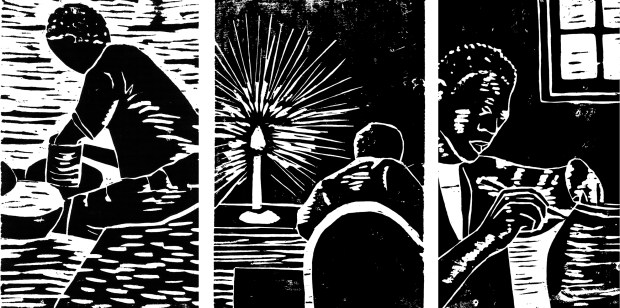
Etched in Clay is poetry inspired by the historical record of an amazing man named Dave (David Drake). Dave was a skilled potter/poet who happened to be enslaved. Cheng speaks for him but doesn’t say too much. It’s just enough. We follow Dave from his teenage years fresh off the auction block to his life as a free man in his seventies. He’s sold and re-sold several times within the Landrum family to work their pottery works. His first owner, Harvey Drake, notices his talent and teaches him how to create pottery. Drake’s religious wife Sarah gives Dave a powerful tool too, a spelling book from which he learns to read and write. In his long life, he is split apart from the women and children he loves, he struggles with his lack of agency as an enslaved man and he REBELS with words and poetry. Words spill out of his head and onto his pottery. Dave finds a way to assert his worth as a human being through the liberatory act of black creativity.

DavethePotterWoodCuts

Image Credit: Lee & Low Books, Andrea Cheng

Harvey Drake (like most whites at the time) is conscious of the danger in nurturing the intelligence of a slave. He’s comfortable in his power and is protective of the system that keeps his whiteness above blackness. Though Dave knows he can be lashed for knowing how to read (and showing it), he does it anyway. Even signing his name on a pot is dangerous yet he does it…and by doing so, he reflects on his legacy (his pots are made to last) and asserts HIS power. His defiance is through words.

Andrea Cheng doesn’t romanticize or soften slavery; she gives us a glimpse of Dave’s reality. I appreciate her honest characterizations of the slave masters and their disregard for Dave’s (and the other slaves’) humanity. The entire book is full of excellent characterization! A masterful storyteller has the ability to make you bubble and boil with frustration yet eagerly reach to turn the page. I wanted to keep going and see what would happen to Dave, a man who, like my ancestors, was remarkable.

The woodcuts in this book are also done by Andrea Cheng and just like the writing, they are just enough (and so much). They give us a glimpse into Dave’s life with blocky shapes, black and white lines and outlines that suggest more than tell. Not only do I recommend Etched in Clay for casual reading, I think it’s perfect for the classroom. There are so many lessons to take away and to discuss and Dave should be more well known. I hope you’ll pick up this book and enjoy.


Recommended for: Ages 11 and up
Great for: Inner Strength, Rebellion, Courage, Determination, Defiance, African American, Slavery, History, Pottery, Creativity, Poetry, Relationships, Black History Month, Black History Month Children’s Books, History-Inspired, Discussion, Classroom
Book Info: Etched in Clay: The Life of Dave, Enslaved Potter and Poet by Andrea Cheng, 2013 Lee & Low Books Inc., ISBN: 9781600604515

Follow the Drinking Gourd

FollowtheDrinkingGourd

Image Credit: Dragonfly Books (Random House), Jeanette Winter

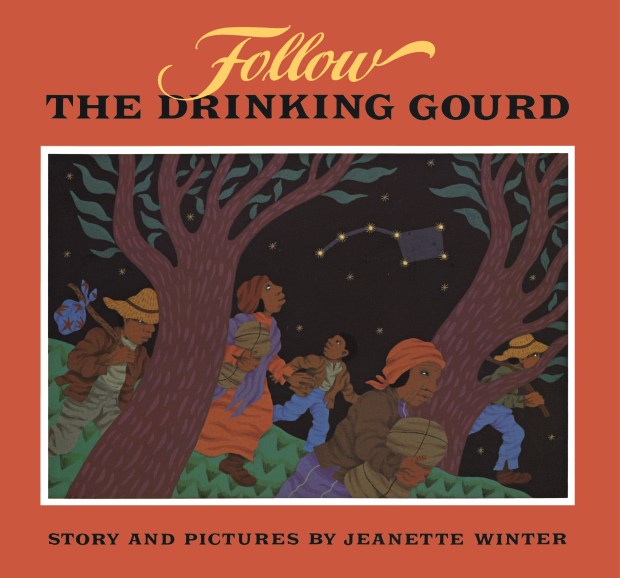
This classic from my childhood discusses the importance of allies on the road to freedom. Abolitionists helped fearless slaves free themselves from oppression. Peg Leg Joe, the abolitionist featured in this story, may or may not have been a real person but the Underground Railroad was definitely real.

In Follow the Drinking Gourd, Peg Leg Joe  works at cotton plantations with the sole purpose of teaching slaves his song, Follow the Drinking Gourd, which tells them how to get to freedom. One day, Molly’s husband James is sold to another master and they have only one more night together. Slaves often had their families suddenly torn apart in this way. But that night they hear a quail’s song, the first clue from the song to get moving towards freedom. They decide to make an escape.

FollowtheDrinkingGourd2

Image Credit: Dragonfly Books (Random House), Jeanette Winter

The family follows the Drinking Gourd (Big Dipper), remembering the lines of Peg Leg Joe’s song for guidance. They hide from hounds and look for signs that they’re heading in the right direction; North. They get help from farmers and finally meet up with Peg Leg Joe who takes them across the Ohio River to their next stop, the house of a white family. They keep moving from house to house and take time to rest and heal and even stay at the place of a free black man. The family finally makes it to Canada, to freedom.

This has always been one of my favorite books about slavery because it presents it in a clear, easy to understand way. Children who have no understanding of slavery will need some explanation as to why the family wants to escape. There are no happy slaves here; we see the family’s hesitation, worry, fear and finally joy and relief. Jeanette Winter’s illustrations are extremely moving; especially the one with James on the auction block, head down and distraught, “Negroes for Sale” below him. I read this book quite often when I was young, so much so that the images are still very familiar to me. Be sure to check it out and discuss! The complete song is included on the last page.


Recommended for: 1st grade and up
Great for: Slavery, Underground Railroad, African American, Injustice, Inner Strength, Fearlessness, Determination, Family, Relationships, Allies, Abolitionism, Astronomy, Black History Month, Black History Month Children’s Books, Non-Fiction, Discussion
Book Info: Follow the Drinking Gourd by Jeanette Winter, 1992 Dragonfly Books (Random House), ISBN: 9780679819974

My Fuzzy!! by Alia Jones

A review I wrote for Nerdy Book Club! OWEN is one of my all time favorites. 🙂

CBethM's avatarNerdy Book Club

Kevin Henkes has won several awards for excellence in illustration and writing. Most recently he won a Caldecott Honor and a Geisel Honor for Waiting, which is a beautiful book. Not only is he a skilled illustrator, he’s a powerful storyteller and when I think of stories that have heavily influenced how I critique (and enjoy) picture books, his always come to mind.

owen

I first read Owen when I was a little girl and that little mouse and his blanket have stayed with me. I’d read it over and over again and even as I read it now, I can’t help but crack a smile because it’s so clever and funny! Many people rally around Chrysanthemum and Lilly’s Purple Plastic Purse (deservedly so) but I want to show some love for little Owen and his awesome parents. It’s ultimately a book about relationships.

Owen is the story of a…

View original post 355 more words

Bad News for Outlaws: The Remarkable Life of Bass Reeves, Deputy U.S. Marshal

BadNewsForOutlaws

Image Credit: Carolrhoda Books (Lerner Publishing Group, Inc.), Vaunda Micheaux Nelson/R. Gregory Christie

“Bass shook his head. He hated bloodshed, but Webb might need killing.” OH SNAP.

The story starts in medias res with an action-packed showdown shootout! Reeves has the tough job of being a lawman in Indian Territory. As Natives were forcibly moved to Indian Territory to live, Whites squatted on the land illegally. The Territory was ripe with outlaws, gamblers and dangerous people. Reeves was the right man to uphold the law; in addition to being clever, well respected and honest, he was a crack shot, tall, broad and strong. He grew up a slave in Texas but escaped after an altercation with his master to Indian Territory. There he lived with tribes and learned their ways and languages until the Civil War when he became free.

Reeves married, had kids and was hired on to be a Deputy Marshal for Indian Territory. Though he couldn’t read, he had an excellent memory and was known for his disguises and clever schemes to track down outlaws. Being a church-going man, he also tried to talk sense into the criminals. Though he was generally respected, he was still a black man with power and many whites weren’t keen on that. When Oklahoma became a state in 1907, Reeves lost his job as Deputy Marshal but later became a part of the Muskogee police force. In his entire career, he only killed fourteen men in the line of duty!!!

BadNewsForOutlaws2

Image Credit: Carolrhoda Books (Lerner Publishing Group, Inc.), Vaunda Micheaux Nelson/R. Gregory Christie

One issue I have with this book is the way in which the author addresses the murder of Reeves’ daughter in law. Reeves’ son Benjamin murdered his own wife because she was “untrue” and though he was sentenced to life, he only had to serve ten years because he was a “model prisoner.” Micheaux Nelson retells historical events (focuses on how tough this is for Reeves) but Reeves’ daughter in law has no agency in this story. She’s the victim of horrific violence yet we never learn her name, we don’t see her in the illustrations and there’s no mention of her in the material at the end of the book. This is unfortunate and I hope readers use this as an opportunity for discussion and to learn more about her. [After about 20 minutes of searching the internet, I found two sources that list her name, Cassie Reeves. Here and here on pg. 39.]

R. Gregory Christie’s illustrations bring Reeves and the unpredictability of the “Wild West” to life. Christie’s color palette is full of sandy browns, rich greens and dark colors. The first page with outlaw Jim Webb bursting through a window (shards of glass flying) to escape from Reeves on horseback is my favorite. By the way, Micheaux Nelson and Christie also collaborated on another excellent book, The Book Itch. Read that one too.

Be sure to check out Bad News for Outlaws: The Remarkable Life of Bass Reeves, Deputy U.S. Marshal. Bass Reeves isn’t as well known as he should be and this picture book is an excellent introduction to his remarkable life.


Recommended for: 3rd-4th grade and up
Great for: Western, Indian Territory, Native Americans, Oklahoma Tribes, Squatters, Fairness, Law Enforcement, Relationships, Family, Law, Discussion, Deputy U.S. Marshal, Outlaws, African-American, Slavery, Injustice, Respect, Black History Month, Black History Month Children’s Books, Non-fiction, Biography
Book Info: Bad News for Outlaws: The Remarkable Life of Bass Reeves, Deputy U.S. Marshal by Vaunda Micheaux Nelson/Illustrated by R. Gregory Christie, 2009 Carolrhoda Books (Lerner Publishing Group, Inc.), ISBN: 9780822567646

Water is Water

WaterisWater

Image Credit: A Neal Porter Book, Roaring Brook Press (Macmillan), Miranda Paul/Jason Chin

In this rhythmical, science read-aloud, we follow a brother and sister through seasons and the water cycle. Like the water cycle, the story is cyclical. It starts in spring-time when the siblings spot a lone turtle in their pond. Water goes into a glass and in a dish for the turtle but it also becomes steam for the hot cocoa they share with their father! Miranda Paul tells a story of water changing in a unique way. Steam is steam but it also changes form to become clouds, which can form low to become fog and on and on.

As I write this review, there’s a light rain and it’s very foggy where I am. Snow is leftover from yesterday and it’s starting to melt as the rain hits it. Maybe I should call my friends and have a snowball fight like the children in this book?!  🙂  Jason Chin does an amazing job of pairing Miranda Paul’s poetic lines with bright and colorful illustrations. He creates a very complete world with his art; after finishing Water is Water, I felt like I knew how to travel from the family’s house to the lake, to school and back again! His watercolor and gouache clouds and fall leaves are beautiful and I enjoyed little details like the reflective, wet pavement on the school grounds.

TJ104-7-2014 JKT 175L CTP.indd

Image Credit: A Neal Porter Book, Roaring Brook Press (Macmillan), Miranda Paul/Jason Chin

The facts at the back of the book about the water cycle are GREAT because they refer to scenes in the book. Children can make connections between the story’s words, illustrations and terms like “evaporation.” This book is for storytime and for science class! Paul writes in an easy to understand way that young children can grasp. The story will make them smile and by the end of the book, they’ll understand how water moves from form to form.

Oh and hey, the children’s parents are black and white!! The story isn’t ABOUT their interracial family…they just happen to be so. It’s a quietly powerful display of diversity. Also the siblings’ friends are very diverse and happy. I love seeing happy children of many ethnicities in a picture book.

Be sure to check out Water is Water with your classroom and family…and go out and play in the rain!!


Recommended for: All ages
Great for: Family, Friendship, Relationships, Diversity, Weather, Seasons, Science, Water Cycle, Recycling, Imagination, Community, Animals, Nature, Read-Aloud, Rhythm
Book Info: Water is Water by Miranda Paul/Illustrated by Jason Chin, A Neal Porter Book, 2015 Roaring Brook Press (Macmillan), ISBN: 9781596439849

Voice of Freedom Fannie Lou Hamer: Spirit of the Civil Rights Movement

VoiceofFreedom

Image Credit: Candlewick Press, Carole Boston Weatherford/Ekua Holmes

“We serve God by serving our fellow man.”

Fannie Lou Hamer spent her entire life doing just that, fighting for black people’s rights to equality and justice. This mighty woman was one of class, power, strength and dignity. I see my grandmother in Fannie Lou Hamer’s big body and I see my mother in her strength despite her weariness. She suffered yet continued to rise and speak, and sing, and empower.

Weatherford does an amazing job (as usual) of crafting Fannie’s voice as we follow her story from childhood to adulthood. The words of the book are a combination of Weatherford’s storytelling and Fannie’s powerful quotes. While reading, I reflected on history and couldn’t help but compare the struggles people faced during her time to those of people of color today. I admire her strength. She grew up poor, the youngest of twenty children, picking cotton in the fields while living and breathing injustice. From an early age, she saw that black people didn’t have it equal; that they had to work hard just to get a little.

Fannie eventually marries and loses the ability to have her own children (her body is policed by white supremacy and classism) but she yearns for change and starts to push for black voters’ rights. Her determination to vote brings attacks on her life but she keeps moving forward to become a leader of the SNCC. Her spirit is never broken. She runs for Congress several times and reaches back to help the younger generation with Freedom Summers. Towards the end of her life she starts programs to help poor folks and also wins a lawsuit to integrate the public schools of her home county in Mississippi.

VoiceofFreddom2

Image Credit: Candlewick Press, Carole Boston Weatherford/Ekua Holmes

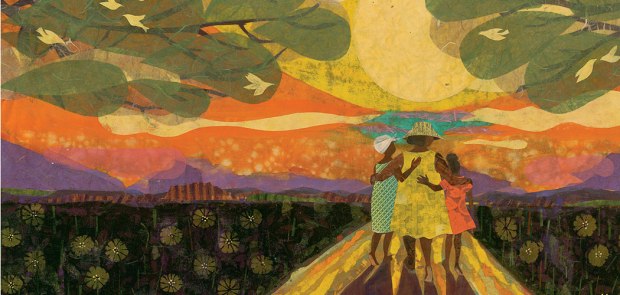
I spent just as much time enjoying Ekua Holmes’ illustrations as I did Weatherford’s words. After reading the rich text I’d turn to the illustrations and let them have their turn speaking to me. So much is packed into her painting-collages; varying shades of brown for skin, angular faces, flower bursts, patchwork, and texture. I love the pages where young Fannie holds a cotton plant quietly as her family members drag the long white bags that resemble ghosts and the final page, an older Fannie’s strong and beautiful profile with the American flag behind her. Weatherford’s books always have amazing art and this one is no exception.

When I think on this woman, I wonder…was there ever a selfish bone in her body? No. Fannie Lou Hamer’s life was in every way about service.

What a picture book. What a way to start many meaningful discussions. Voice of Freedom Fannie Lou Hamer: Spirit of the Civil Rights Movement is deserving of all the honors it has received.

We’re still pushing ahead Fannie.


Recommended for: 2nd Grade and up
Great for: Civil Rights, Diversity, Discussion, Jim Crow, Segregation, Racism, Community, Family, Relationships, Black Girl Magic, Strength, Determination, Friendship, African-American, Social Issues, Social Justice, Injustice, Black History Month, Black History Month Children’s Books
Book Info: Voice of Freedom Fannie Lou Hamer: Spirit of the Civil Rights Movement by Carole Boston Weatherford/Illustrated by Ekua Holmes, 2015 Candlewick Press, ISBN: 9780763665319

Ruth and the Green Book

RuthandtheGreenBook

Image Credit: Carolrhoda Books (Lerner Publishing Group, Inc.), Calvin Alexander Ramsey/Floyd Cooper

Family vacations are an American staple right? They’re when we take time away from our jobs to get in a car, train or plane to travel and have fun. But can you imagine needing to rely on a little book to help you stay safe on the road? The danger isn’t from other cars or weather conditions; the danger is from people who don’t like you because of the color of your skin.


Ruth and the Green Book is a story based on real historical events. Like Ruth and her family, in the 50s, many Black families were prospering in the North but had to take precautions when traveling, especially back down South and into Jim Crow. In this story, Ruth’s dad gets a brand new car and they head from Chicago to Alabama to visit grandparents. Ruth tells the story from her perspective and we experience her confusion and anger towards segregation. She doesn’t understand why they can’t use the restroom at the gas station and why the white hotel owner won’t let them stay in the hotel but she sees the effects these events have on her family.

NegroMotoristGreenbook

Image Credit: Wikipedia.org (New York Public Library) 1940 Edition of The Negro Motorist Green-Book

“Whites Only” signs are everywhere on their journey but her family sings joyfully as they drive and enjoy each other’s company. They make do as oppressed people do! Ruth learns the hard truth about Jim Crow, but luckily a family friend along the route tells them to look out for Esso Gas Stations. Esso is one company that accepts black business. At the first Esso Gas Station they see, a black worker sells them The Negro Motorist Green Book which lists safe places for Black people to eat, sleep and rest on the road. As they travel, Ruth grows up and makes a new friend at one of the inns they stay at. The Green Book helps Ruth and her family get to Alabama safely and she reflects on how thankful she is for a nationwide network of black people looking out for each other!

I love Cooper’s illustrations. He uses muted colors of browns, greens, and blues and it gives the feel of an old soft crackly television. Warm, expressive brown faces and Ruth’s loving family are beautiful to see. I really like the design of the cover of the book with its swooping green retro font, Dad’s brand new “sea mist” green Buick, and Ruth smiling proudly as her mom holds her steadily (strength, determination and a little worry in her expression.) This book is excellent for ALL ages because it discusses an important (and probably little-known) aspect of Black History. Check it out and talk about it!


P.S. For more information on The Negro Motorist Green Book and to browse through one online, click here and here. These links are super cool. I really encourage you to take a look!


Recommended for: 1st Grade and up
Great for: Civil Rights, Diversity, Discussion, 1950s America, Jim Crow, Segregation Community, Family, Relationships, Friendship, Travel, African-American, Social Issues, Determination, Injustice, Black History Month, Black History Month Children’s Books
Book Info: Ruth and the Green Book by Calvin Alexander Ramsey/Illustrated by Floyd Cooper, 2010 Carolrhoda Books (Lerner Publishing Group, Inc.), ISBN: 9780761352556