A Chat With Duncan Tonatiuh

Duncan Tonatiuh’s work is some of the most important work in children’s literature right now. His books speak truth, teach our realities and his art isn’t too bad. 😉 He creates picture books that cover topics like immigration, city vs. rural life, friendship, art history, discrimination, prejudice, determination and history. You can read my reviews for Funny Bones and Salsa here.

Funny Bones was the very first book I reviewed for my blog, so it holds an important place in my blogging life. Through reading and experiencing his books, I became more interested in learning about him. He’s a very cool person! Let’s get on to the interview…


AliaQ1. What are three words to describe yourself?

Duncan: Thats a tough one. One would be responsible or dependable.

Alia: Yeah I know! I like to ask people this though…

Duncan: Creative maybe? Smart sounds conceited but something to do with being a thinker. Thoughtful?  That is what I can think of for now.

Alia: That’s great. Thank you.

Duncan: Calm maybe?

Alia: 🙂

Duncan: No problem.

AliaQ2. Congratulations on your baby daughter! Has having a child influenced how you see yourself as a storyteller?

Duncan: I’m sure it has. But I’m not quite sure how yet. It’s definitely had a huge impact in my life. My world does not revolve around me anymore by any means. And I feel an enormous and unconditional love for my daughter. It’s a wonderful feeling.

AliaQ3. The first time I saw your books, your art made me cheer. It’s such a beautiful display of indigeneity. The Mixtec codex influence. Do you mind discussing your style and how it developed?

Duncan: I went to design school in New York City. There is a large Mixtec community there. I became friends with a Mixtec guy named Sergio. For my senior thesis I decided to make a small comic book about his journey from his small village in the south of Mexico to working as a busboy in a restaurant in New York.

One of the first things I did when I began that project was go to the library to look up Mixtec artwork. I found images of Mixtec codex from the 15th century. I was blown away by them. I grew up in Mexico, so I was familiar with Pre-Columbian art but never paid much attention to it. When I saw images of the codex at the library I decided I would make a modern day codex of Sergio’s story.

I began emulating the drawings from the codex. I drew every one in profile. I stylized their ears to look like a number 3. I drew the character’s entire bodies, etc. I collaged my drawings digitally though to make them feel more modern.

Alia: That’s awesome! You kind of touch on that modern day application of art in your book about Diego Rivera. How he’d view the world now and create it in his style. I love how you take ancient art from your culture and make it modern for today’s children. I really really like how you use digital collage too! It makes the images pop.

Duncan: Thanks!

Alia: No problem!

DuncanTonatiuhInterview2

Image Credit: Dear Primo, Abrams Books for Young Readers, Duncan Tonatiuh

Q4. What was your favorite food growing up?

Duncan: Hmmm. Maybe enchiladas or pozole. When I was a kid I asked my mom why my Dad always got to pick what we were having for lunch. She said it was because he gave her the money to buy the food. At some point I got a job after school helping out a jewellery maker. When I got paid I gave the money to my mom and asked her to make enchiladas.

Alia: Hahaha. That sounds like something my mom would say. 🙂

Duncan: lol

AliaQ5. Your books are very powerful and full of history and perspective. They also have the ability to reach any child in the world. What do you hope children take away from your books?

Duncan: Thanks! Well, first and foremost I hope they find my books entertaining and interesting to look at. I make books about things that interest me. Hopefully young readers will find those things interesting and important too. I try to have a message in my books but I hope they don’t feel preachy or didactic.

When it comes to Latino children I hope they see themselves, their family and their community in the books. Hopefully they feel pride and realize that their voices and stories are important. For non-Latino children, I hope they learn about a different culture. With books like Pancho Rabbit or Separate Is Never Equal, I hope that they feel empathy and understanding of the struggles Latino children and people have to face sometimes.

One of the most rewarding moments I’ve had as an author is when a group of 4th graders from an Elementary in Texas wrote a multi-voice poem about their border crossing experiences after they read Pancho Rabbit. I feel my book encouraged them to speak and realize that their voices and stories are important. Let me find the link:


Alia: Thank you for sharing and that is amazing. I’m glad for your books because it is so important to not only share stories, but to create stories that children can relate to. Children of color sometimes need that boost, that representation. That’s why diverse books are so important. For teaching and learning, and inspiring as in the case of those 4th graders! 🙂

Duncan: 🙂

AliaQ6. Congratulations on all the recent honors (Sibert Award/Pura Belpré Honor/NCTE Honor) for Funny Bones! Have you received any feedback from kids on that book?

Duncan: Thank you! I’ve received a few calavera drawings from students. And I’ve seen projects that they’ve created at school for the Day of the Dead. I look forward to receiving more feedback from kids and seeing how they respond to the book and what resonates with them.

Alia: How cool! When I was a teacher in Korea, I learned about Day of the Dead to share with my students. In Korea, they have a holiday called Chuseok where they also honor ancestors, make an altar of food, and clean graves. They seemed to connect with it, especially since they saw some cultural similarities. They were a little surprised about the calaveras though. But when I showed them the sugar skulls, they wanted to taste them. lol!

Duncan: lol

Alia: Yeah my students were cute.

DuncanSalsa1

Image Credit: Salsa, Groundwood Books, Duncan Tonatiuh

Q7. For the book Salsa, you illustrated words that weren’t your own. What was it like working with Jorge Argueta?

Duncan: The majority of picture books are written by one person and illustrated by another one. The publishing company pairs the two together. I did not meet Jorge until after I had illustrated the book. That is often the case with picture book authors and illustrators. I enjoyed illustrating Jorge’s book and we have become friends, but we didn’t work on that book together; at least not at the same time.

I finished illustrating a book recently for another author, a woman named Susan Wood. We’ve only met once very briefly. I enjoy illustrating other people’s stories but I like writing and illustrating my own books the best because I have a little more control. I can change the text or the illustrations as I need and hopefully that makes the book flow more smoothly.

Alia: That’s really interesting. I’ve also noticed that for some smaller publishers, the author can have some say in who they’d like to work with and there’s more dialogue during the creative process. I think the book came out really nicely.

Maybe also, like any piece of art, a book that is written and illustrated by you is your complete piece and like you said, you can tweak and bend the product to be exactly what you like and want to say.

Duncan: Definitely. And I’m not sure but I think the publisher asked Jorge if he thought I would be a good fit for the manuscript he wrote. He didn’t give me comments on my illustrations and sketches but he had the opportunity to look at some of my work first I believe.

Alia: Thanks for the insight!

Q8. You touched on it a bit above but are there any upcoming projects you can share with the public yet?

Duncan: I have two picture books coming out this fall. One will be called The Princess and the Warrior; A Tale of Two Volcanoes. I wrote and illustrated it. It’ll be published by Abrams. The book is my own version of the origin legend of two volcanoes that are outside of Mexico City: Popocatépetl and Iztaccíhuatl. The story is set in Pre-Columbian times and it has some similarities to Sleeping Beauty and Romeo and Juliet.

The second book is called Esquivel! Space-Age Sound Artist. It’s written by Susan Wood and illustrated by yours truly. It’ll be published by Charlesbridge. The book is about a Mexican composer who is considered the creator of lounge music. It was fun to illustrate. It’s a groovy and swanky book with a lot of hand-drawn text in it.

Alia: Oh man, I’m looking forward to both!!

Duncan: Thanks! Me too!

AliaSide note: While studying your books for this interview, it was fun to see how your art style has evolved over time. In Dear Primo compared to Funny Bones, your lines now are a little cleaner, the hands of the people are smaller and they have necks! So interesting to see.

Duncan: Yeah. That is true. Sometimes I miss some of the rawness of Dear Primo. I am hoping to experiment a little more with upcoming projects. I want them to still be in my style but I also want them to evolve or change a little depending on the project.

Alia: Looking forward to how your style grows.

Q9. Any place or food you really recommend during a visit to your hometown of San Miguel de Allende?

Duncan: San Miguel is a great place to visit. A few years ago it was voted “Best City in the World” by Traveler’s Magazine. I think one of the things that visitors like about it is that there is nice combination of high-end and cheap options. There are some really good fancy restaurants but also great cheap street tacos.

My favorite place in town is probably the library. It has a wonderful courtyard. I love going there to write, draw and read. Some good places for visitors are the crafts market, the botanical garden, the Fábrica la Aurora -an old factory that was converted into art galleries- and the hot springs.

Alia: Fábrica la Aurora sounds sweet! A great space for creativity. Thanks for sharing!


Thank you Duncan for taking time to talk with me. I really enjoyed our conversation and I’m excited for all the books coming from you (this year and years to come!). Yay!

Be sure to check out his:

Website, http://www.duncantonatiuh.com/

Facebook Page, https://www.facebook.com/DuncanTonatiuharte/?fref=ts

Blog, https://duncantonatiuh.wordpress.com/ 


Thanks for reading! ❤

Joelito’s Big Decision

Joelito'sBigDecision

Image Credit: Hard Ball Press, Ann Berlak, Daniel Camacho, José Antonio Galloso

This book discusses making change and social justice in an easy way for children to understand. They can connect to Joelito, his friend and his struggle to make a big decision. It’ll get your children thinking about what they can do to improve our world and to ensure that everyone makes a living wage.

In Joelito’s Big Decision, Joelito wakes up Friday morning thinking about his family’s weekly trip to MacMann’s for burgers! At school, when his sister’s best friend’s backpack is stolen, he makes a comment that she can just go buy another one; he doesn’t get that his family is economically in a better place than his friend’s. Excited to finally get his burger, his family heads to MacMann’s but there are a lot of people standing outside with signs and no one’s eating. A big protest is happening because MacMann’s pays low wages and the workers can’t live on what they make. Turns out his best friend Brandon’s mom and dad work there and they’re a part of the strike too! When Brandon invites Joelito to join the strike, Joelito is hesitant (he wants to sit and eat his burger!) and he has to decide what is most important to him.

JoelitosDecision2

Image Credit: Hard Ball Press, Ann Berlak, Daniel Camacho, José Antonio Galloso

Joelito has to step outside his comfort zone. Until he encounters the strike, he doesn’t really notice that his friend’s family is struggling to make ends meet. Things become personal for him and he empathizes. Sometimes, something as simple as giving up a favorite treat can show how much you care for someone…and for a cause.

Daniel Camacho’s illustrations are very cool. I like the raw sketchy quality of the color pencil, his use of color, and the large, chunky bodies and hands of his figures. His illustrations suit the story very well. An extra treat to this book is that it’s bi-lingual (English & Spanish) and this duality will make it accessible to more children, which is excellent and needed.

I really recommend this book for discussion and learning. Teachers, look at this page from Hard Ball Press for ideas on how to use this book in the classroom!


Recommended for: 1st grade and up
Great for: Social Justice, Social Issues, Friendship, Change, Economic Inequality, Empathy, Family, Immigrants, Latin-American, Low Wages, Moving, Perspective, Poverty, Relationships, Spanish Language, Struggles, We Need Diverse Books, Diversity
Book Info: Joelito’s Big Decision by Ann Berlak/Illustrated by Daniel Camacho/Translated by José Antonio Galloso, 2015 Hard Ball Press, ISBN: 9780986240096


Where Do We Go When We Disappear?

WheredoWeGoWhenWeDisappear

Image Credit: Tate Publishing, Isabel Minhós Martins/Madalena Matoso

I first discovered author Isabel Minhós Martins through The World in a Second. Because I enjoyed that book so much, I wanted to read more of her work. I found a few more titles of hers at my local library. Not all of her books are translated to English yet (from Portuguese) but out of the few I could get my hands on, I thought this one was very good.

Death, loss and change aren’t easy topics to discuss at any age and I know that parents often look for books that gracefully tackle these subjects. What I like about Where Do We Go When We Disappear? is that it’s very reflective, thought provoking and it isn’t necessarily about death, so parents can use this book however they need.

Martins says that for someone to disappear, someone must first notice the disappearance. Therefore, it always takes at least two people for someone’s loss to be recognized; for the missing to begin. And with the missing begins the questions and Martins opens the story to the discussion of disappearance of all kinds of things in our world! This can help a child begin to make connections and start healing. Even socks disappear, for example! (Who knows where they go??) Nothing lasts forever and some things take longer to disappear. But everything doesn’t disappear to NOTHING. Matter is recycled, exchanged and shifts and on and on it goes…

WhereDoWeGo2

Image Credit: Tate Publishing, Isabel Minhós Martins/Madalena Matoso

Martin’s evocative text is accompanied by Matoso’s bold illustrations. The bright, blocky illustrations are just enough for the text, to spark discussion. Smiling humans, sad humans, trees, winding roads, nature and the ocean; the pictures are strong yet gentle. Where Do We Go When We Disappear? is a beautiful book that’s good for all ages. It does a great job of starting conversations about existence, life, death and change.


P.S. For parents looking for a secular book about death, this book does mention “heaven” but in relation to where puddles go to eventually become clouds. It’s quite interesting.


Recommended for: All ages
Great for: Discussion, Change, Death, Family, Loss, Nature, Permanence, Reflection, Relationships, Sadness
Book Info: Where Do We Go When We Disappear? by Isabel Minhós Martins/Illustrated by Madalena Matoso, 2013 Tate Publishing, ISBN: 9781849761604

My Seneca Village

MySenecaVillage

Image Credit: Namelos, Marilyn Nelson


My Seneca Village is a mighty work. Marilyn Nelson, as she describes in the introduction, connected to the people of Seneca Village while spending years researching the community and this is very evident in how heartfelt and moving this collection of poems is. Seneca Village was a community in New York City located where Central Park now is. It was a community of mostly African American families, with Irish, German, Jewish and some Native Amerian residents. It existed from 1825 to 1857; in 1857 all residents were forced to move out by the city in order to build the park. With this forced removal came the end of a rich, vibrant and thriving community.

What My Seneca Village does so beautifully is bring Seneca Village back to life. Through original poems, Nelson honors and creates a voice for its residents. We learn their stories, we see young dreamers, young love, life, death, gossips, mischievous children, racism and strength. Some of the residents we meet are real people who lived in Seneca Village, others are fiction and we also meet huge historical figures, like Frederick Douglass, who stop through the village to give moving speeches. It’s hard to narrow this book into one category because it does so much. Nelson’s poetry is powerful. One of my favorite stanzas is from the village’s Reverend Rush during an anti-abolition riot:


                                      “I asked everyone to bow their heads and pray.

                                        Pray for this nation’s struggle to be free

                                        for ALL Americans. Equality

                                        must be bitter, if you’ve always been on top,

                                        and you’re slapped awake out of a lifelong sleep.

                                        Pray we’ll pull together toward a common hope.”


Over a hundred years later and we’re still struggling for the same thing. I’m glad for this story. I’m glad to know about Seneca Village, I’m glad that this novel is being read nationwide and I encourage you to read this book and travel to Seneca Village.


P.S. Just wanted to note how nice this book is. Namelos is a small publisher and I can’t remember the last time I picked up a book with such nicely inked letters.

Also, here’s an interesting NPR article about the play The People Before the Park.


Recommended for: 12 and up
Great for: Poetry, Everyday Life, Community, History, Seneca Village, American History, African American, Diversity, Cultural Diversity, We Need Diverse Books, Racism, Family, Love, Friendship, Relationships, New York, Eminent Domain, Injustice, Central Park
Book Info: My Seneca Village by Marilyn Nelson, 2015 Namelos, ISBN: 9781608981960

The Girl With a Brave Heart: A Tale from Tehran

TheGirlWithABraveHeartCover

Image Credit: Barefoot Books, Rita Jahanforuz/Vali Mintzi

I’m a sucker for traditional “folktale” stories! Reminiscent of Cinderella, Shiraz has her hardships and her rewards and The Girl With a Brave Heart shines due to its interesting and magical story with vibrant illustrations. There’s a soothing quality to the format of a well written folktale and this one is great for reading aloud.

The Girl With a Brave Heart tells the story of kind Shiraz, whose father has passed away and she lives with her stepmother and stepsister, acting as a maid for them. One day her cherished ball of wool blows into her neighbor’s garden so she goes to fetch it. A ragged old lady lets her in in exchange for Shiraz’s labor. She tells Shiraz to do three chores that involve destruction (smash all the things in her kitchen with a hammer, for example), but Shiraz understands what she really needs and helps her. The old lady rewards her with specific instructions for dipping into the two pools in the back on her way home.

When Shiraz arrives home, ball of wool in hand, her family doesn’t recognize her because her beauty is stunning! Eager to find out what happened, her greedy stepmother and stepsister Monir concoct a plan for Monir to get her beauty as well. But the character of a person is their most important aspect and Monir…when she rushes to find her “lost ball of wool”she gets exactly what she deserves for her selfishness.

GirlWithaBraveHeart

Image Credit: Barefoot Books, Rita Jahanforuz/Vali Mintzi

This book is gorgeous. The cover has gold foil on it. 🙂  I first spotted part of the cover image on Barefoot Books’ Twitter page and asked them where it came from because I had to know more about it. Vali Mintzi has amazing style and isn’t afraid to use color. Her gouache paints are bold; she uses strong lines, dabs of color here and there and with just a few strokes, she brings to life the colorful city of Tehran. I love how she gives her characters long noses and shades half their faces with another color. It reminds me of Picasso’s faces.

Though this story does follows the traditional folktale tradition where goodness is equated with beauty, I don’t fault the story for it. Shiraz’s heart is pure and for her kindness, she’s given a gift. Perhaps your family or classroom can discuss folktales and fairytales that break tradition! This is an excellent addition to any collection.

Recommended for: All Ages
Great for: Friendship, Family, Discussion, Folktale, Helping Others, Inner Beauty, Inner Ugliness, Kindness, Morals, Read-Aloud, Relationships, Selfishness, Tehran
Book Info: The Girl With a Brave Heart: A Tale from Tehran by Rita Jahanforuz/Illustrated by Vali Mintzi, 2013 Barefoot Books, ISBN: 9781846869297


My Two Blankets for Multicultural Children’s Book Day!

MCBookDay-white-2

Woo Hoo! 😉


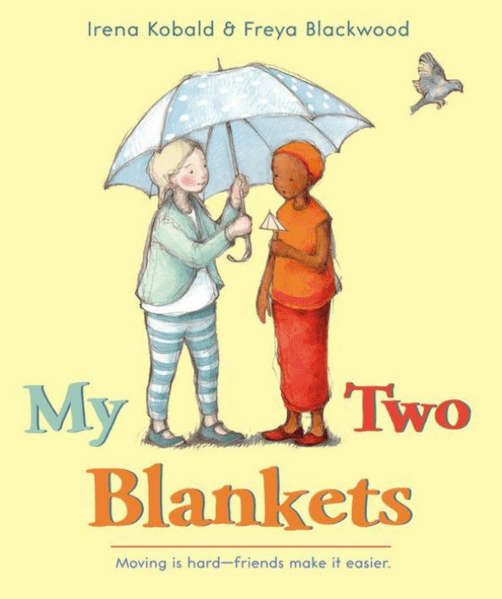
MyTwoBlankets

Image Credit: Houghton Mifflin Harcourt, Irena Kobald/Freya Blackwood


Multicultural Children’s Book Day (January 27th) is a beautiful effort to share the love of multicultural books! I have the pleasure of participating this year. Thank you to MCCBD and Houghton Mifflin Harcourt for providing me with a copy of the book My Two Blankets!

My Two Blankets discusses the struggles that immigrant children may face when leaving their home and making a new one. In recent years, there have been more and more picture books that discuss this topic and it’s encouraging to see. It’s important to think about the experiences of others and picture books have the power of bringing a whole new world of understanding to children! It’s also important for these children to know that their stories matter. 

The story opens with Cartwheel playing happily in her village in Sudan, but soon war comes and she moves to another country (possibly Australia) with her Auntie. Everything is strange and jarring for her; the people, the food, and especially the language! She’s frustrated by her confusion and she feels like she’s losing her identity. At home, she’s able to soothe herself under a “blanket” of familiar words and sounds. One day, she meets a girl in a park who talks strangely, like everyone else, but her kindness draws her in. The girl teaches Cartwheel her language, a little at a time, and their friendship blossoms. She begins to feel more confident, a new blanket growing alongside her old one.

MyTwoBlankets2

Image Credit: Houghton Mifflin Harcourt, Irena Kobald/Freya Blackwood

I enjoyed this book very much, but I do have one very important suggestion for how the story can be improved. Cultural exchange is crucial for creating a better, multicultural world. Readers don’t get to see Cartwheel share her original blanket (her culture, stories and WORDS) with her friend. We only see the friend teach Cartwheel her language and not the other way around. The additional imagery of a blended blanket, red and blue, with her friend having a similar blanket, would’ve been powerful. Cartwheel teaches her friend how to do cartwheels, but I hoped to see much more! I encourage families and teachers to think about this while reading the book and maybe it will spark healthy discussion!

The illustrations in My Two Blankets are beautiful. I enjoy Blackwood’s style; the wiggly, sketchy lines around the oil and watercolor paints create a feeling of movement and energy. The contrasting reds and blues make the images stand out and she is excellent at depicting soft expressions. I love how she uses symbols to represent words that float in the air, are held by the girls and absorbed by Cartwheel.


Please take time to read this book, discuss the story, and enjoy the illustrations. Touching back on the importance of cultural exchange, below is a video recipe for Sudanese Blended Okra Meat Stew or Bahmia Mafrook! Maybe this is something Cartwheel ate in Sudan and continued to make with Auntie in her new home. It’s also a dish she could’ve shared with her new friend. I hope your family will try it and enjoy! 🙂

Ah, it looks so tasty!

Recommended for: All Ages
Great for: Friendship, Immigration, Diversity, Relationships, Frustration, Struggles, Struggle With Identity, Inner-Strength, Support, We Need Diverse Books, Family, Discussion, Sudan, Australia
Book Info: My Two Blankets by Irena Kobald/Illustrated by Freya Blackwood, 2014 Houghton Mifflin Harcourt, ISBN: 9780544432284


Multicultural Children’s Book Day (MCCBD)

Our mission is to not only raise awareness for the kid’s books that celebrate diversity, but to get more of these of books into classrooms and libraries.

Our Mission: The MCCBD team’s mission to spread the word and raise awareness about the importance of diversity in children’s literature. Our young readers need to see themselves within the pages of a book and experience other cultures, languages, traditions and religions within the pages of a book. We encourage readers, parents, teachers, caregivers and librarians to follow along the fun book reviews, author visits, event details, a multicultural children’s book linky and via our hashtag (#ReadYourWorld) on Twitter and other social media.

Founders: The co-creators of this unique event are Mia Wenjen from Pragmatic Mom and Valarie Budayr from Jump Into a Book/Audrey Press. You can find a bio for Mia and Valarie here.

Sponsor Info

Multicultural Children’s Book day 2016 Medallion Level Sponsors!

Platinum: Wisdom Tales Press * StoryQuest Books*Lil Libros

Gold: Author Tori Nighthawk*Candlewick Press,* Bharat Babies

Silver: Lee and Low Books*Chronicle Books*Capstone Young Readers T

Tuttle PublishingNY Media Works, LLC/KidLit TV

Bronze: Pomelo Books* Author Jacqueline Woodson*Papa Lemon Books* Goosebottom Books*Author Gleeson Rebello*ShoutMouse Press*Author Mahvash Shahegh* China Institute.org*Live Oak Media

Co-Hosts

Multicultural Children’s Book Day has 11 amazing Co-Hosts and you can read more about them here.

Furthermore, here are the links to the co-hosts’ individual sites: All Done Monkey, Crafty Moms Share, The Educators’ Spin on it, Growing Book by Book, Imagination SoupI’m Not the NannyInCulture ParentKid World Citizen, Mama Smiles, Multicultural Kid Blogs, and Spanish Playground.

Classroom Reading Challenge!

Attention Teachers! Check out this awesome opportunity to earn a FREE hardcover multicultural children’s book for your classroom. Follow this link to the MCCBD website for more information. Also, click here for a free MCCBD poster for your classroom!


A Chat with Daniel Miyares

I first discovered Float sitting on the new books table of my bookstore. You see, I had a ritual of familiarizing myself with the new crop every Tuesday; excited to find a new favorite. I picked up the small gray book, took some time to flip through the pages…and kept the story with me.

When I started my blog, I knew I had to review it. I’ve been fortunate enough to get to know Daniel Miyares a bit and he was kind enough to let me interview him. Really, it turned into a great conversation. Hope you enjoy our chat.


Alia: Q1. What are three words to describe yourself?

Daniel: Ummmm…introvert, unorganized (or as I like to say intuitive), heartfelt.

Alia: I’m introverted too! Yay for introverts! 🙂

Daniel: Yay! Let’s get together and feel anxious.

Alia: Q2. I know you’re married with kids. Has your family given you any ideas/inspiration for projects?

Daniel: YES, absolutely my family gives me inspiration everyday. I am married. My wife’s name is Lisa and we have two little children together. I always like to say my best story ideas come from some sort of anxiety or character flaw that I have. Couple that with the fact that children and marriage can be some of the most honest mirrors you’ll ever come across and you’ve got a free flowing fount of possible story fodder.

I do see a lot of my children’s way of looking at and experiencing the world make it into my stories. Not just the innocence, but the honesty of their emotions. I see the ups and downs of Float almost everyday in my house in one way or another. It’s true and sweet.

AliaQ3. My dad was an artist, so I grew up surrounded by art. Do you have artists in your family? Have you noticed your children taking a strong interest in art?

Daniel: My dad took a few art classes in college I believe, but he never pursued it. My daughter really loves art. She’s always got a project going. I can count on her to sit with me if I need a painting buddy. It’s fun to talk art and design with her. It’s like I have some inside track on all the stuff that hasn’t been “taught” out of her. She frequently schools me on color. My colors are never sparkly enough for her. 🙂

Alia: Cool! Yeah I agree with her. I love sparkly but then there has to be balance. I’ve also noticed that children often have insight that we are too old and too “trained” to have.

Daniel: So right! That’s why I feel like I’m continuing to learn about my own books. The more I share them with children the more insight I walk away with.

Alia: Kids are pretty sweet. I learned a lot from my students when I was a teacher.

Daniel: I bet you did! What did you teach?

Alia: I taught Elementary school English in Korea for four years.

Daniel: That’s so wonderful. I’m sure you’ve got stories. I should interview you about that!

Alia: Haha. Oh yeah I have a lot. It’s all kinda a blur of dirty noses, screaming kids and lots of laughs.

Q4. I love the paintings you post on Instagram and Facebook. Are you a paper margin doodler?

Daniel: I am a margin doodler, an over the important information doodler, an on my desk and chair doodler. It’s kind of an obsession. Thank God someone invented Instagram. Now I have a place to put all those random scribbles. Actually it’s been freeing to post things without much editing. I can get pretty calculated when it comes to making art and I need to be reminded to loosen up and not worry about it so much.

Alia: It must be nice to just make art for arts sake when it’s your JOB to make art. Just put it out there and go!

Daniel: It is nice to just make art without a big agenda. It also reminds me of the things I love about making pictures.

AliaQ5. Okay big question. Why do you make picture books? What do YOU get out of it?

Daniel: Okay this is a biggie. Picture books kind of found me. I had always loved drawing and painting, as well as secretly writing poetry, but I never dreamed of making picture books. A friend introduced me to my artist rep and through working with them I realized that the things I love about making illustrations and telling stories could be really meaningful in picture books. I suppose what I get out of it is the sense that I’m using more of the whole of my creative self on a project. For me there is an emotional cycle to the process of making a book- the passion and uncertainty of conceiving an idea, the anxiety of pitching/selling it, the craft and focus of making it, all ending with the joy of sharing it with so many people. It’s a roller coaster and I feel in love with it.

Alia: Ah what a great answer. I love it! 🙂

Daniel: Great question!

Alia: Thanks!

Q6. What kind of jelly do you like on your PB&J? lol

Daniel: Grape. Absolutely, Grape. Smuckers if it’s on the shelf, but the generic store brand works too. Every now and again I do make a monster PB&J. You know the one with the extra piece of bread in the middle?

Alia: Classic. Good choice. But I’m more about Welch’s Grape. I’ve never done a monster PB&J and now I’m wondering why I haven’t. Haha

Daniel: Me too!

Alia: I guess I have to try it now!

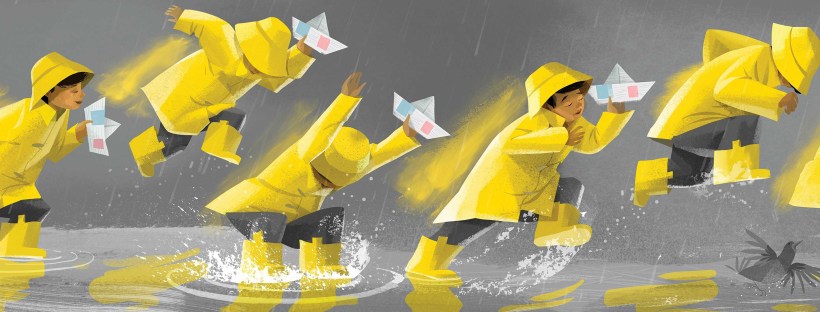
FloatDounpour

Image Credit: Simon & Schuster, Daniel Miyares

Q7. Where did Float‘s story grow out of? The book-making process can be quite long. Can you remember any big or tough edits you made to the story or design of Float?

Daniel: I was on a plane flying home from my Aunt’s funeral. It had been raining so I did a drawing of a little boy floating a paper boat in a puddle. I wondered what happened before that moment and drew that. Then I wondered what happened after that moment and drew that. I went on like this until I found the beginning and end of the story. The book making process is quite long and requires you to stay focused on what’s best for the story throughout. That’s how I know I’m working with good collaborators- if they honestly critique with that lens. Hurdle one for me with Float was should it have words or not. It seemed like a strong visual narrative that took you to all the emotional places necessary without words, but I wasn’t sure. I tried a whole string of variations on the manuscript, but none of it seemed to say anything that the pictures weren’t. My editor Kristin Ostby at S&S was great about helping to weigh and measure that. At one point I wrote a sound poem for the story. I’d still like to do something with it someday. I’m actually thinking of trying to do some readings of Float in the music rooms of elementary schools instead of a regular class. I figured the children could help tell the story with the instruments. Kind of a rainy day orchestra! Another hurdle or edit was how to get all the emotional beats into the story in an interesting way. Panels seemed like a logical way to pace things out and reveal information as the reader needed it. It was just another layer of design that became really important once I got into building the book.

Alia: Doing readings of Float in music rooms sounds awesome! I can see kids really getting into that.

Daniel: Yeah I’d like to give the instruments a try.

AliaQ8. I read Float as a story about imagination and delight in play. What were your favorite imagination activities or games as a child?

Daniel: My favorites were drawing, building forts or hideouts, exploring the woods, playing in the creek near my house. The spaces weren’t that big, but they seemed like whole different worlds. I don’t know how many makeshift boats and action figures met their end in that creek.

Alia: Me too. I grew up in the city but I loved making forts out of sheets in my room. Crawl inside and…read books.

Daniel: Those little hiding spots were the best.

Alia: Yup!

Q9. Do you like origami? Origami used to be MY THING so I enjoyed the paper-folding element of Float very much.

Daniel: I do. I’ve worked at Hallmark Cards as an artist for the past twelve years. I’ve gotten to make a lot of things out of paper in that time. It has always amazed me how just a blank piece of paper can take on a life of its own.

Alia: Well that’s pretty cool. I always wonder about card artists. There are so many well designed and unique cards out there.

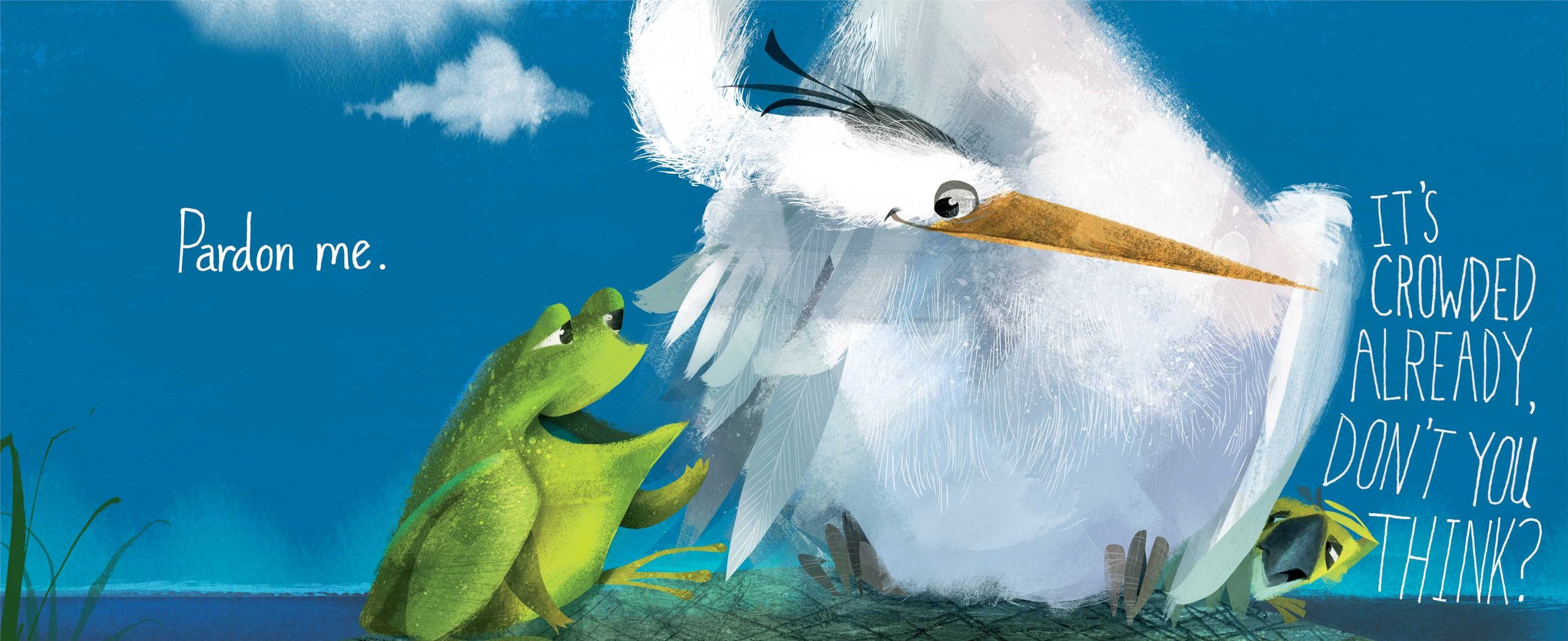
PardonMe

Image Credit: Simon & Schuster, Daniel Miyares

Q10. While preparing for this discussion, I realized that Pardon Me is your book and I got really happy because I think that book is a little dark and very hilarious. Can you share some background on that book?

Daniel: Absolutely, remember what I said about starting with an anxiety or character flaw for a story idea? That’s how Pardon Me! started. I’m introverted so I like to have my alone time and think space. With a family I’m often scheming of ways to find those quiet moments. So I imagined the little bird as me. I can try to cling to what I think is right, fair and deserved even to my detriment. In short, I just took a look at what was making my blood boil and I wrote it down. I just had to substitute interruptions with animals.

Alia:  Ohhh, I see and I totally understand! Very cool. I’m imagining the animals as your family now!

Q11. What are you thoughts about efforts like We Need Diverse Books and the general push for diversity in publishing and literature?

Daniel: It’s so critical that children have access to books that celebrate a wide range of cultures and experiences. I see it either challenging and expanding what they know about the world or affirming who they are. I feel like I as an individual can choose to invest in projects that help to do that, but I have to tell stories that lean into my point of view. I have very specific memories from growing up where I read a book or a poem and it churned something up inside of me. It widened my gaze in a way that I never would have on my own. That gives me hope that if talented authors and artists from all different ethnicities, ages, genders, and sexual orientations continue to lean into their experiences to craft meaningful stories, then there will be those kinds of transformative intersections. Of course it’s important for that focus on diversity to be present at all points of the book making process-all the way to a child having the book in hand. Over the past few years I’ve gotten to meet so many wonderful book champions who strive to do just that.

Alia: When I think back to books that shaped me growing up, they’re all kinds of books but I definitely connected to seeing little girls who looked like me.

Daniel: Sure, we all want to feel like we belong and are understood.

Alia: Q12. I think I read that you’re from South Carolina? Serious question…Do you like grits?

Daniel: Oh my, yes I do love grits. I was raised on them and biscuits. One of my favorite breakfast foods.

Alia: Yes! Okay, even more important question. How do you like them? Butter? Salt? Cheese? I love biscuits too. My grandma made great ones.

Daniel: I used to take a serving of grits and put scrambled eggs, butter and bacon in them then cover it with cheese.

Alia: OMG…

Daniel: I know…gross.

Alia: Hahaha. We cook ours with butter in the water, add a little salt and I like a side of scrambled eggs too. Sometimes I add cheese.

Daniel: This is all making me really hungry. I would’ve eaten just fine at your house.

Alia: Haha. Yes. My family is from Alabama and Mississippi so I grew up with good Southern Cooking.

Q13. Do you mind sharing a little bit about your next two books Surf’s Up and Bring Me a Rock!?

Daniel: I don’t mind at all. Surf’s Up is a collaboration with the amazing Kwame Alexander. He wrote it and I illustrated. It’s the story of two frog friends, Bro and Dude. Bro just wants to read his book and Dude just wants to get to the beach. It’s really a celebration of the power of reading and imagination. Kwame’s dialogue is fantastic. It is releasing Feb. 1st. Bring Me A Rock! is my next book with Simon & Schuster. I’m the author and illustrator on this one. In it a megalomaniac insect king demands that all of his loyal subjects bring him a rock. He’s going to build a majestic pedestal fit for a king. It’s about how his kingly plans don’t go as expected and how the day is ultimately saved by the most unexpected hero. It’s out June 7th.

Alia: They both sound really cool. I’m looking forward to both! I love the names Bro and Dude haha. That’s awesome.

Daniel: I know! When I read it with my kids we crack up so hard. They call each other Bro and Dude for the rest of the night.

Alia: I feel like teachers are going to enjoy reading that one aloud with their students!

Q14. ALA Midwinter Conference is underway and the Caldecott Medal winner will be announced on Monday. You already know I’m rooting for you…How do you feel about all the love you’re getting for Float?

Daniel: Never in my wildest dreams did I imagine so much love being poured out on Float. You know when you’re making a book you do your best to craft the best story experience you can, but once it’s released it takes on a life of it’s own. I’ve been overwhelmed by all the kind and generous people I’ve gotten to meet along the way such as yourself! It’s given me a more well rounded view of the book community. I’m in awe.

Alia: I honestly think that when a book gets love like Float is getting, it’s partially a reflection of the author’s spirit because you put so much of yourself into every aspect of the book. Float has kinda flown under the radar and into people’s hearts because it’s that good. 🙂

So thank you for sharing stories.

Daniel: Alia, I appreciate all the support you’ve given to me and Float. I’m so grateful for the opportunity to share them.

Alia: Of course! Okay final question!

Q15. Are you a fan of BBQ and if so, what’s your favorite place in Kansas City?

Daniel: I’m required to be a fan of BBQ if I live in KC. It’s in the contract. There are so many places to go if you’re coming this way, but by far my favorite is a place called Joe’s KC. It used to be called Oklahoma Joe’s. It’s in a gas station and it’s worth the wait every time.


I want to thank Daniel Miyares once again for taking time to talk with me. It was a fun chat and I wish you and Float THE BEST on Monday for the ALA Youth Media Awards!

Be sure to check out his:
Website, http://www.danielmiyares.com/ and Instagram, https://www.instagram.com/danielmiyaresdoodles/

Thanks for reading! ❤

Freedom in Congo Square

FreedomInCongoSquare

Image Credit: Little Bee Books (Bonnier Publishing Group), Carole Boston Weatherford/R. Gregory Christie

In this beautiful book, we learn about the slaves of New Orleans who toiled and eagerly anticipated their day of rest because on that day, they headed to Congo Square to let their bodies flow freely and revel in the music and culture of home. Congo Square was their place of freedom, their chance to celebrate who they were and simply enjoy each other’s company. Eventually Jazz would develop out of the music played at this space.

Freedom in Congo Square has an excellent Forward and Author’s Note that I highly recommend reading. Taking time to summarize and teach the history is important because it adds to the experience of the book. Children with knowledge of slavery will easily understand how important a day to rest, a day to celebrate was to slaves. It’s easy to see the joy and relief in their bodies as they dance and sing and drum. Weatherford’s poetic language and description of plantation life during each day of the week builds anticipation for what readers know is coming, that glorious Sunday.

CongoSquare2

Image Credit: Little Bee Books (Bonnier Publishing Group), Carole Boston Weatherford/R. Gregory Christie

The rhythm and rhyme of this book is great for reading aloud to children and Weatherford always has the coolest illustrators for her books. Leontyne Price: Voice of a Century is both textually and visually gorgeous. Freedom in Congo Square is no different. Christie’s collaged paintings are inspiring; the slaves have black, beautiful skin highlighted with blue-gray and long, limber bodies. Their long limbs are bent over in the cotton field BUT are also outstretched in jubilation at Congo Square. I love the bright, joyful colors of his paints and the cover of the book is striking with its use of yellow and black.

This is an excellent book that tells the story of an important safe and creative space for enslaved people during Slavery. What a great new release for 2016! If your family takes a trip down to New Orleans, why not add Congo Square to your list of places to visit?


Recommended for: 1st-2nd Grade and Up
Great for: History, Slavery, Celebration, Determination, Music, Music History, New Orleans, Community, Family, We Need Diverse Books, Diversity, Cultural Diversity, Oppression, Spirituality, Discussion, Days of the Week, Rhyme, Rhythm, Read Aloud, Jazz, African American, Africa
Book Info: Freedom in Congo Square by Carole Boston Weatherford/Illustrated by R. Gregory Christie, 2016 Little Bee Books (Bonnier Publishing Group), ISBN: 9781499801033

Growing Up Pedro

GrowingUpPedro

Image Credit: Candlewick Press, Matt Tavares

Let me get this off my chest…I’m not a baseball fan and I think that’s why it took me so long to pick up this book. I didn’t read it until I decided to participate in a Twitter Chat (SharpSchu) to discuss it. Sometimes I have to remind myself to open my eyes and embrace everything. I’m still not big on baseball but Growing Up Pedro isn’t just about baseball; it’s about the amazing relationship between brothers Ramón and Pedro Martínez.

The size of this picture book is large; it’s designed to be opened wide and fully experienced. As soon as you open the first page, you’ll see a sweeping landscape of the Dominican Republic in 1981 and little brown boys playing stickball. This sets the tone of the story where we’ll learn how two great baseball players came to dominate American baseball.

GrowingUpPedro

Image Credit: Candlewick Press, Matt Tavares

From an early age, Pedro admires his big brother Ramón’s skill and they practice together, throwing balls at the ripe mangos hanging from the trees. Eventually Ramón makes it to the LA Dodgers in 1985 and when he leaves for America, Pedro becomes more determined than ever to follow him. Ramón learns from his struggles and makes sure that Pedro is better in English than him when he’s ready to join him in the Major Leagues. Pedro isn’t as big as Ramón (this will cause some to doubt his ability) but his heart is just as big if not bigger. Heart pumping full of determination, he makes it to the Minor-Leagues just as his big brother is making waves on the Dodgers.

The brothers end up on the Dodgers, together. But before he knows it, Pedro is traded to Montreal! He continues to shine due to his inner strength and the support of his big brother. He DOMINATES as a pitcher and eventually surpasses even his brother in skill. Pedro goes to the Red Sox and later Ramón joins him again and together they lead the Red Sox to the American League Championship Series. Throughout their career, the Martínez Brothers are the pride of the Dominican Republic and never forget where they come from.

Tavares’ watercolor and gouache illustrations are dynamic. As I mentioned earlier, the wide, sweeping landscapes are gorgeous. I particularly enjoy the scenes of young Pedro and Ramón against the green trees, in shorts and caps, playing baseball with their friends and having fun! Baseball lovers will appreciate the almost photorealistic paintings of the brothers during their prime, pitching on the mound with determination in their eyes. If you’re looking for an excellent story about brotherhood, love and reaching for your dreams (oh and baseball 😉 ), pick up Growing Up Pedro!

P.S. If you buy this book, be sure to remove the jacket and check out the cover!! It’s really cool and brings the story full circle. Also, this book will be published in Spanish soon! SWEET!


Recommended for: 2nd Grade and up
Great for: Brotherhood, Ripe Mangos, Siblings, Relationships, Role Model, Admiration, Dreams, Determination, Coming of Age, Diversity, Cultural Diversity, We Need Diverse Books, Community, Friendship, Baseball, Biography, Sports, Sports History, Pedro Martínez, Ramón Martínez, LA Dodgers, Boston Red Sox, Montreal Expos, Dominican Republic, Inner-Strength
Book Info: Growing Up Pedro by Matt Tavares, 2015 Candlewick Press, ISBN: 9780763668242

Ask Me

AskMe

Image Credit: Houghton Mifflin Harcourt, Bernard Waber/Suzy Lee

Ask Me, written by Bernard Waber and posthumously published with illustrations by Suzy Lee is so sweet. The little girl in the story enjoys a fun day with her dad. As they spend time together, she asks him to ask her questions about her likes and reminds him about things she loves. They’re both attentive towards each other while being totally a part of their autumn surroundings. Their relationship is very solid and loving and I appreciate the fresh style of the writing; the story is essentially dialogue between the two. The pace and delivery of the story (also the illustrations) remind me of another great book about a father and daughter, Sidewalk Flowers.

AskMe2

Image Credit: Houghton Mifflin Harcourt, Bernard Waber/Suzy Lee

Lee depicts a messy piggy-back ice cream treat, romping through the falling leaves and dad pretending to be a bear. These are just a few of the tender moments in this book. I love the way she uses colored pencil and long, scratchy strokes to create the vibrant reds, oranges and yellows of fall leaves. Not only is the story comforting, but the colors and her sketchy-style of illustration is as well and readers will love this father-daughter relationship. What a cute book!

P.S. Another book that starts on the end pages (like Remy and Lulu)! Watch them get ready for their day out. 🙂


Recommended for: All ages
Great for: Family, Relationships, Father-Daughter, Colors, Animals, Autumn, Nature, Community, Read-Aloud, Love, Environment, Discussion
Book Info: Ask Me by Bernard Waber/Illustrated by Suzy Lee, 2015 Houghton Mifflin Harcourt, ISBN: 9780547733944