Ragweed’s Farm Dog Handbook

RagweedFarmdog

Image Credit: Candlewick Press, Anne Vittur Kennedy

This is, hands down, one of the funniest picture books of 2015! Love it. It makes me miss my crazy Ibizan hound Loki and his shenanigans…

In Ragweed’s Farm Dog Handbook, Ragweed is a confident little fellow. He wrote a handbook so that other dogs can follow his lead on how to be the best farm dog ever. Ragweed tells us all the things that are not a farm dog’s job BUT…if a farm dog were to do them, there might be biscuits involved. He really shouldn’t wake the farmer but…if he does he’ll get a biscuit to go away! He knows EXACTLY what he’s doing. The writing of this book is very formulaic and funny and kids will be able to follow along easily. There’ll be lots of laughs and maybe a few “ewwws” too? 😉

Anne Vittur Kennedy’s beautiful acrylic paintings really create the spirit of farm life and Ragweed is so adorable! That little scoundrel with his huge eyes, scraggly hair and long snout is sure to win your heart. He also has great expressions and the animals do too (they know to keep an eye on him!). Hope you enjoy this one as much as I did!


Recommended for: All ages
Great for: Humor, Animals, Dogs, Relationships, Farm Life, Love, Read-Aloud
Book Info: Ragweed’s Farm Dog Handbook by Anne Vittur Kennedy, 2015 Candlewick Press, ISBN: 9780763674175

Happy to Be Nappy

HappytobeNappy

Image Credit: Jump at the Sun (Hyperion Books for Children), bell hooks/Chris Raschka

If I could ask any illustrator to draw my portrait, I’d choose Chris Raschka because I see myself in his illustrations.

Sitting still in a chair while mom, aunt or grandma cornrows/straightens/combs/dries our hair is something many black women grow up experiencing. One of my best memories is when my dad would sit me in front of him and speed dry my dreads with a towel, making me laugh. Hair care is a past-time, talking time, learning time and…waiting time. Oh sometimes it takes so long. >_<

“Nappy” is a term that means “unkempt” or “messy” or generally “rough” in black-hair-speak. If someone says your hair is nappy, it’s not a nice thing to say. Black women have a long history of resisting (or accepting) western hair norms but we’re always creative. We embrace our natural curls, we straighten, we twist, we curl, we weave, we grow afros. Black hair culture is fascinating.

HappyToBeNappy2

Image Credit: Jump at the Sun (Hyperion Books for Children), bell hooks/Chris Raschka

Happy to Be Nappy is bell hook’s book for little black girls and their hair. It’s about loving your hair in every capacity. Sometimes it’s frizzy, sometimes it’s neatly braided, sometimes it’s flat but it’s always a crown. This book celebrates being happy with the way you look and proud of the way you feel and pairs excellently with I Like Myself!  Any child can relate to the happiness and confidence exhibited by the girls in this book.

Chris Raschka’s art is perfect. His watercolor and bold black lines bring Happy to be Nappy to life. The pages are filled with blotchy colors, wide and thin strokes and swoops of black piled on top of brown faces with simple, beautiful expressions. Raschka really lets the watercolor soak into the paper and the results are gorgeous. ❤

I’m so nappy happy I discovered this book and I hope you’ll seek it out to enjoy too! 🙂


Recommended for: All ages
Great for: Hair, Black Hair, Girl Power, Happy, Empowerment, Family, Relationships, Pride, Black Girls Rock, Black Girl Magic, Confidence, Self Esteem, Diversity, Read-Aloud, Rhyme
Book Info: Happy to be Nappy  by bell hooks/Illustrated by Chris Raschka, 1999 Jump at the Sun (Hyperion Books for Children), ISBN: 9780786804276


Alphablock

Alphablock

Image Credit: Abrams Appleseed (Abrams), Christopher Franceschelli/Peskimo

Quality design is important. Eye-catching graphics and clever construction can set a book apart from the rest.

Alphablock is a dynamic board book. Along with Take Away the A, this is one of my favorite ABC books. With its chunky build and interactive pages, it’s perfect for learning and discovering! The first page gets right down to it, flip the letter A and you’ll learn that A is for…Apple. The A blends into the page before it and we’re presented with a scene (a picnic).

Alphablock2

Image Credit: Abrams Appleseed (Abrams), Christopher Franceschelli/Peskimo

Alphablock is great for storytelling. What’s going on? Why do you think they’re having a picnic? What other fruits are on the page and so on. Parents and teachers can use this book in many ways to work on reading, vocabulary and word-picture association. Peskimo’s digital illustrations are bold and fabulous. Hope you’ll pick up this one and explore the alphabet.


Recommended for: Babies, Toddlers, Early Readers
Great for: ABC, Early Childhood Development, Word Picture Association, Interactive, Animals, Foods, Vocabulary, Early Learning, Discussion
Book Info: Alphablock by Christopher Franceschelli/Illustrated by Peskimo, 2013 Abrams Appleseed (Abrams), ISBN: 9781419709364

Look What Brown Can Do!

LookWhatBrownCanDo

Image Credit: Sweetberry Books, T. Marie Harris/Neda Ivanova

I don’t know about you but I’m very aware of the fact that I come from greatness. Though I can’t tell you much about my ancestors, I DO know that they lived and loved and are the reason why I’m here today.

The excellent thing about Look What Brown Can Do! is that it’s about empowerment, specifically black empowerment. For a young black child, reading this book can cloak them in a blanket of comfort, pride…and inspiration! For other children, it’s a great book about black history/accomplishments that can inspire them too. The book is sectioned into art, music, business, science and more. T. Marie Harris writes an encouraging sentence about what brown can do and then we see photographs and descriptions of three important black heroes. In many ways, this book is a simpler version of the Empak Black History Series and is more “young kid friendly” because of the fun illustrations.

LookWhatBrownCanDo2

Image Credit: Sweetberry Books, T. Marie Harris/Neda Ivanova

Neda Ivanova’s digital illustrations are cute. It’s beautiful to see little brown children dream of being scientists, doctors, athletes, artists and government officials. I was especially drawn to the cover! I happened to see it online one day and thought to myself, “Oh that looks interesting!” I love the different shades of brown hands and arms busy creating and dreaming together.

This book is the first in Harris’ upcoming ‘Black Like Me’ series which will feature stories that celebrate blackness and everyday life. She writes that sometimes it’s nice to read a fun story with your children that has black characters but doesn’t necessarily focus on race. I SO agree. Though there’s always a need for those books, it’s refreshing to read about kids of color…just being kids! I’m pleased to know and share this book. Please check out Look What Brown Can Do!

P.S. You can check out T. Marie Harris’ website at http://www.lookwhatbrowncando.com and follow her on Twitter at @T_MarieHaris.


Recommended for: All ages
Great for: History, Black History, Black Excellence, Encouragement, Inspiration, Leaders, Occupations, Dreams, Read-Aloud, Science, STEM, Government, Arts, Sports, Medicine, Business, Beg. Reader, Community
Book Info: Look What Brown Can Do! by T. Marie Harris/Illustrated by Neda Ivanova, 2016 Sweetberry Books, ISBN: 9780692483862

When Marian Sang

WhenMarianSang

Image Credit: Scholastic Press, Pam Muñoz Ryan/Brian Selznick

Take a look at that cover!

Not only is the cover beautiful, well designed and eye-catching, the entire book is gorgeous.

The story begins with young Marian in her house, set in the middle of a grand stage. When Marian Sang is a moving and beautifully told story of the life of singer Marian Anderson. There was never a moment she didn’t love to sing and people loved to listen. She was passionate about her faith and her music and by the age of eight, was performing for choruses in Philadelphia. Early on, Marian decided that music was something she wanted to dedicate herself to but because of her race, she was turned away from formal lessons.

Prejudice is intertwined with Marian’s story. Even though she was invited to sing across the country, she couldn’t even get a hotel room! But she continued to rise and share the gift of her voice with the world. Like Josephine Baker, she came back to the US and faced the challenge of performing as a black woman. The D.A.R. might’ve denied her performance at their hall but little did they know Marian’s spirit was destined for greatness. Eleanor Roosevelt and President Roosevelt set her up to perform at the Lincoln Memorial instead!! That performance was groundbreaking and memorable not only for the integrated crowd that witnessed it, but for the entire country. Marian continued to sing, inspire and move audiences for years to come.

WhenMarianSang2

Image Credit: Scholastic Press, Pam Muñoz Ryan/Brian Selznick

The art!! Selznick uses rich acrylics and his palette is lush and golden. He uses only browns, golds, rose golds, pinks, and creams for entire book. The layout is very wide and grand. The large pages are perfect for highlighting his art. His paintings glow and the combination of his art with Pam Muñoz Ryan’s beautifully poignant writing is perfect. What a team, what a book and what a story of an amazing woman!

P.S. Take some time to read through the notes in the back about the author and illustrator’s loving and thorough research. Also check out Leontyne Price: Voice of a Century. She was inspired by Marian Anderson!

#BlackGirlMagic #InternationalWomensDay


Recommended for: All ages
Great for: Family, Love, Relationships, Faith, Music, Girls in Music, Diversity, Black Girl Magic, Black Girls Rock, Determination, Inner Strength, Prejudice, Segregation, Choir, Opera, Spirituals, Integration, Philadelphia, Europe, Non-fiction, Biography
Book Info: When Marian Sang by Pam Muñoz Ryan/Illustrated by Brian Selznick, 2002 Scholastic Press, ISBN: 9780439269674

Dear Primo: A Letter to My Cousin

DearPrimo

Image Credit: Abrams Books for Young Readers, Duncan Tonatiuh

If you’ve followed my blog for a while, you’ll know that Duncan Tonatiuh is one of my favorite author/illustrators. Not only does he write great stories, he’s an amazing artist. I got the chance to read this book (his very first one!) while preparing for my interview with him and I’ve also reviewed his more recent books Salsa and Funny Bones.

Dear Primo is a story about two cousins. Carlitos lives in Mexico, in the country and on a farm and Charlie lives in a big city in the United States. They write letters back and forth to each other, explaining their daily lives and the things they like to do. While Carlitos rides his bicicleta to school every day past the perros and nopal, Charlie rides the busy subway, which he describes is like a long metal snake that travels underground. The duality of the storytelling makes it easy for children to compare and contrast. At the end of the story, both boys come up with the same conclusion; it’s time to visit each other! 🙂

Though it seems their lives are very different, there are more similarities than differences. Duncan incorporates Spanish words into the text and they’re also printed in bold, white letters in the illustrations. Children can pick up the words and definitions easily, matching visuals to the words.

I’ll never get enough of Duncan Tonatiuh’s art style. Inspired by Mixtec codices, his figures are inspired by the past and updated for modern day. He uses digital collage for texture; an image of blue jean for Charlie’s pants and images of marbles for Carlito’s game of canicas! I love the well-balanced cover with crinkly lined paper in the background. As I mentioned to Duncan in our interview, it’s interesting to see how his lines have become cleaner and more polished over the years. Dear Primo‘s art is much more “raw” as he put it, compared to his most recent book Funny Bones, but I enjoy the art of both for their similarities and differences. Teachers, this book is great to introduce a unit on pen-pals. I think you’ll enjoy Dear Primo. Check it out!


Recommended for: All ages
Great for: Family, Cousins, Friendship, Duality, Relationships, City Life, Country Life, Culture, Cultural Relativism, Games, Daily Life, Traditions, Mexico, Mexican-American, Food Culture, Mexican Food, Spanish Language, Pen-Pals
Book Info: Dear Primo: A Letter to My Cousin by Duncan Tonatiuh, 2010 Abrams Books for Young Readers, ISBN: 9780810938724

Etched in Clay: The Life of Dave, Enslaved Potter and Poet

EtchedinClay

Image Credit: Lee & Low Books, Andrea Cheng

I never had the chance to meet Andrea Cheng but I handled her books, I sold them. I was in the same space as them. A Cincinnati author, talented and kind are some of the things people told me about her. Interestingly enough, I’ve been connected to her for quite some time though; I went to school with one of her daughters, Ann. Recently I was able to reconnect with Ann and spend time with two of Andrea’s close writer friends. Here’s what I can say about Andrea Cheng, now that I’ve read her words for myself and can reflect on her people; her voice is strong and she’s left a legacy of goodness.

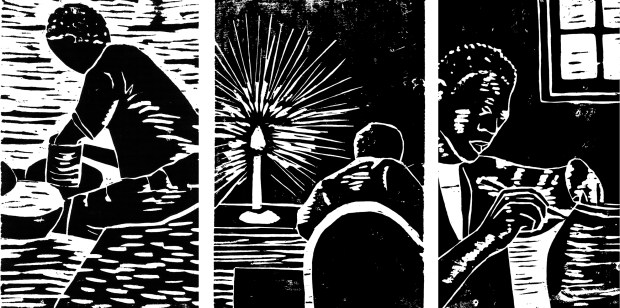
Etched in Clay is poetry inspired by the historical record of an amazing man named Dave (David Drake). Dave was a skilled potter/poet who happened to be enslaved. Cheng speaks for him but doesn’t say too much. It’s just enough. We follow Dave from his teenage years fresh off the auction block to his life as a free man in his seventies. He’s sold and re-sold several times within the Landrum family to work their pottery works. His first owner, Harvey Drake, notices his talent and teaches him how to create pottery. Drake’s religious wife Sarah gives Dave a powerful tool too, a spelling book from which he learns to read and write. In his long life, he is split apart from the women and children he loves, he struggles with his lack of agency as an enslaved man and he REBELS with words and poetry. Words spill out of his head and onto his pottery. Dave finds a way to assert his worth as a human being through the liberatory act of black creativity.

DavethePotterWoodCuts

Image Credit: Lee & Low Books, Andrea Cheng

Harvey Drake (like most whites at the time) is conscious of the danger in nurturing the intelligence of a slave. He’s comfortable in his power and is protective of the system that keeps his whiteness above blackness. Though Dave knows he can be lashed for knowing how to read (and showing it), he does it anyway. Even signing his name on a pot is dangerous yet he does it…and by doing so, he reflects on his legacy (his pots are made to last) and asserts HIS power. His defiance is through words.

Andrea Cheng doesn’t romanticize or soften slavery; she gives us a glimpse of Dave’s reality. I appreciate her honest characterizations of the slave masters and their disregard for Dave’s (and the other slaves’) humanity. The entire book is full of excellent characterization! A masterful storyteller has the ability to make you bubble and boil with frustration yet eagerly reach to turn the page. I wanted to keep going and see what would happen to Dave, a man who, like my ancestors, was remarkable.

The woodcuts in this book are also done by Andrea Cheng and just like the writing, they are just enough (and so much). They give us a glimpse into Dave’s life with blocky shapes, black and white lines and outlines that suggest more than tell. Not only do I recommend Etched in Clay for casual reading, I think it’s perfect for the classroom. There are so many lessons to take away and to discuss and Dave should be more well known. I hope you’ll pick up this book and enjoy.


Recommended for: Ages 11 and up
Great for: Inner Strength, Rebellion, Courage, Determination, Defiance, African American, Slavery, History, Pottery, Creativity, Poetry, Relationships, Black History Month, Black History Month Children’s Books, History-Inspired, Discussion, Classroom
Book Info: Etched in Clay: The Life of Dave, Enslaved Potter and Poet by Andrea Cheng, 2013 Lee & Low Books Inc., ISBN: 9781600604515

Josephine: The Dazzling Life of Josephine Baker

Josephine

Image Credit: Chronicle Books, Patricia Hruby Powell/Christian Robinson

A passionate woman full of energy, charisma and magic was Josephine Baker.

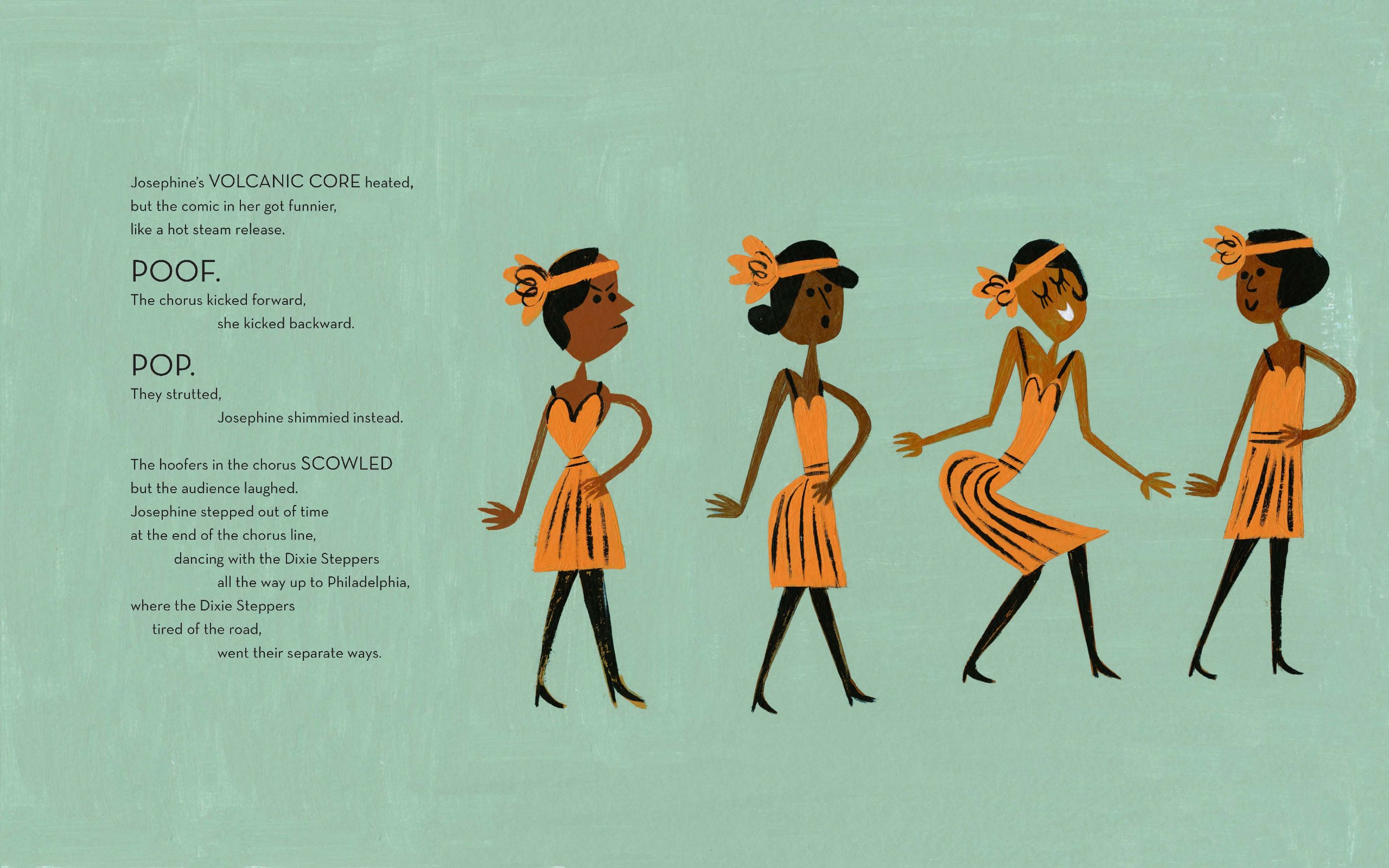
Patricia Hruby Powell uses the metaphor of volcano to describe Josephine’s personality and I think this is perfect. Ever since a little girl, she bubbled and popped and fizzled with pent up energy to perform and dance. She was born poor in segregated St. Louis to a single mother who also loved to dance. They shared a love of vaudeville. As a child she started out in the group The Jones Family but quickly moved on to The Dixie Steppers. Even in a chorus line she stood out with her distinct, silly style. She got hitched, went to broadway and used her smarts to get onstage and SHINE.

Look how spunky and charming she is in the film Zouzou (1934)!

Though she loved to perform, Josephine was tired of segregation and just barely getting by. She got the chance to head to Paris where as soon as she stepped off the steam ship, she wasn’t discriminated against because of her color and felt truly beautiful! She took Paris by storm, charming the entire city, headlining shows, staring in movies and drawing crowds with her energy and risqué banana skirts. She was in every way fabulous, scandalous and daring. When war came she spied for France and became a hero.

As she got older, she remarried and adopted twelve children from all over the world; her rainbow tribe. Though she worked hard to support her children and keep up her lavish lifestyle, she was put out of their mansion, the bills too much to pay. Luckily her friends helped her family and years later, at sixty-seven years old, she decided to give the US one more try. It was a success! America loved her and dear Josephine danced herself to eternal sleep.

Josephine2

Image Credit: Chronicle Books, Patricia Hruby Powell/Christian Robinson

The rhythm and energy of the writing in this book suits Josephine’s personality. It’s broken very cleverly into “acts” of her life. Robinson’s illustrations, as usual, are vivid and beautiful. His signature long bodied figures are perfect for Josephine’s limber body. The book opens with a red curtain, each “act” is introduced by a scene on a stage and finally, after we finish reading the story, the red curtain returns, flowers stewn on the floor below it. I love this touch. It brings the story full circle; she lived for performance. Robinson says in the end notes that he’s been connected to Josephine Baker’s story ever since he was young and it’s very evident in the loving way he depicts her.

Josephine has become one of my favorite biography picture books. It’s one that my bookstore never carried and I kept reading about online. I kept thinking “I’ve GOT to read that book!” After reading Josephine (or maybe even during, like I did), you’ll want to look up photographs and videos of this AMAZING woman. What a woman she was…


Recommended for: 2nd grade and up
Great for: Dance, Vaudeville, African-American, Segregation, Determination, Black Girls Rock, Black Girl Magic, Confidence, Courage, Rhythm, Energy, Paris, Black History Month, Black History Month Children’s Books, Non-Fiction, Discussion, Biography
Book Info: Josephine: The Dazzling Life of Josephine Baker by Patricia Hruby Powell/Illustrated by Christian Robinson, 2014 Chronicle Books, ISBN: 9781452103143

Follow the Drinking Gourd

FollowtheDrinkingGourd

Image Credit: Dragonfly Books (Random House), Jeanette Winter

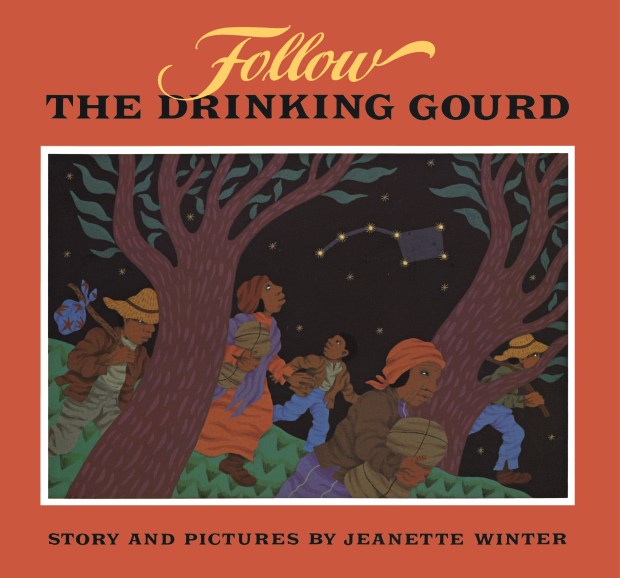
This classic from my childhood discusses the importance of allies on the road to freedom. Abolitionists helped fearless slaves free themselves from oppression. Peg Leg Joe, the abolitionist featured in this story, may or may not have been a real person but the Underground Railroad was definitely real.

In Follow the Drinking Gourd, Peg Leg Joe  works at cotton plantations with the sole purpose of teaching slaves his song, Follow the Drinking Gourd, which tells them how to get to freedom. One day, Molly’s husband James is sold to another master and they have only one more night together. Slaves often had their families suddenly torn apart in this way. But that night they hear a quail’s song, the first clue from the song to get moving towards freedom. They decide to make an escape.

FollowtheDrinkingGourd2

Image Credit: Dragonfly Books (Random House), Jeanette Winter

The family follows the Drinking Gourd (Big Dipper), remembering the lines of Peg Leg Joe’s song for guidance. They hide from hounds and look for signs that they’re heading in the right direction; North. They get help from farmers and finally meet up with Peg Leg Joe who takes them across the Ohio River to their next stop, the house of a white family. They keep moving from house to house and take time to rest and heal and even stay at the place of a free black man. The family finally makes it to Canada, to freedom.

This has always been one of my favorite books about slavery because it presents it in a clear, easy to understand way. Children who have no understanding of slavery will need some explanation as to why the family wants to escape. There are no happy slaves here; we see the family’s hesitation, worry, fear and finally joy and relief. Jeanette Winter’s illustrations are extremely moving; especially the one with James on the auction block, head down and distraught, “Negroes for Sale” below him. I read this book quite often when I was young, so much so that the images are still very familiar to me. Be sure to check it out and discuss! The complete song is included on the last page.


Recommended for: 1st grade and up
Great for: Slavery, Underground Railroad, African American, Injustice, Inner Strength, Fearlessness, Determination, Family, Relationships, Allies, Abolitionism, Astronomy, Black History Month, Black History Month Children’s Books, Non-Fiction, Discussion
Book Info: Follow the Drinking Gourd by Jeanette Winter, 1992 Dragonfly Books (Random House), ISBN: 9780679819974

Martin de Porres: The Rose in the Desert

MartindePorres

Image Credit: Clarion Books (Houghton Mifflin Harcourt), Gary D. Schmidt/David Diaz

Martin de Porres was born to an African/Native slave mother and a Spanish nobleman father in the barrios of Lima, Peru. The priest of a cathedral reluctantly baptized him, not knowing or caring that Martin would grow to be a true man of God. Martin lived with his mother and sister in poverty until he was 8 years old when his father came and took them to Ecuador. Martin came back to Lima to be an apprentice to a surgeon (a cirujano) and excelled at it.

Because he was African, people were prejudiced towards him but his skills were obvious. He was gifted lemon seeds for helping a man and after planting them, the next day a tree grew. At fifteen he wanted to become a priest but was denied the opportunity due to his mixed-blood. He offered to clean, wash and care for the monastery instead. People started to notice his gift with animals and his amazing healing powers. He performed miracles. Everyone, from the poor to the rich, came to him when in need. After many years of service he was allowed to become a priest, was finally seen as a brother, and continued his good deeds until his death.

MartindePorres2

Image Credit: Clarion Books (Houghton Mifflin Harcourt), Gary D. Schmidt/David Diaz

The illustrations are absolutely gorgeous and soft. I also love Diaz’ work in Wilma Unlimited. He has a very distinct style. My favorite spread shows Martin blissfully surrounded by a horse, chickens, mice and dogs. They all show their love and appreciation for him and he gives it back just as much.

To his mother, Martin was always a Rose in the Desert but finally, despite his brown skin and heritage, he was seen as the true rose he was, by everyone. Martin de Porres was beatified in 1837 and finally canonized in 1962. He is the first black saint in the Americas! How fitting this caring and spiritual man of color be named the patron saint of brotherhood, those of mixed race, animal shelters, interracial relations and social justice!

I like finding unique stories. I’m glad to be able to share this one with you for Black History Month. 🙂


Recommended for: 1st grade and up
Great for: Catholicism, Saints, Miracles, Mixed-Race, Injustice, Discrimination, Peru, Helping Others, Animals, Community Service, Love, Black History Month, Black History Month Children’s Books, Non-Fiction, Discussion, Biography
Book Info: Martin de Porres: The Rose in the Desert by Gary D. Schmidt/Illustrated by David Diaz, 2012 Clarion Books (Houghton Mifflin Harcourt), ISBN: 9780547612188