Wild Berries

WildBerries

Image Credit: Simply Read Books, Julie Flett


Guess what? It’s still Native American Heritage Month! Yippee!  If you didn’t see my first post celebrating this month, please check out my review for Hiawatha and the Peacemaker!

Wild Berries is a sweet little book. Julie Flett is Cree-Metis and lives in Vancouver, BC. Wild Berries is written in English with words translated into the n-dialect (Swampy Cree) of Cree. This particular dialect of Cree is from the Cumberland House area of Saskatchewan. As you enjoy the story, you can also pick up a few Cree words. Flett includes more information about the various dialects of Cree and a pronunciation guide at the back of the book.

In this book, Little Clarence and his grandmother set out for the day, exploring nature and picking all types of berries. Clarence starts out on her back but grows into a boy who is curious about his surroundings. He especially loves big, sour ininimina (blueberries). There are many animals in the woodlands and when his bucket is full of sweet berries, he is sure to leave a few as a gift for the animals…and they are thankful. The readers get a gift as well, Flett includes a recipe for Wild Blueberry Jam at the end of the story.

Flett’s style reminds me of cut paper though it looks to be watercolor and digital illustration. She uses basic shapes to make eyes, arms, animals and trees. The bright red orange sun follows the grandma and her grandson as they enjoy the day together. Maybe you’ll want to go berry picking after reading this book, I know I sure want to!  Come on spring.  🙂

Recommended for: All ages
Great for: Diversity, Native American Heritage Month, Cree, Language, Colors, Food Culture, Family, Animals, We Need Diverse Books
Book Info: Wild Berries by Julie Flett, 2013 Simply Read Books, ISBN: 9781897476895

Golden Domes and Silver Lanterns: A Muslim Book of Colors

GoldenDomesSilverLanterns

Image Credit: Chronicle Books LLC, Hena Khan/Mehrdokht Amini


Islam. Let’s celebrate it through a picture book, shall we?  🙂

Golden Domes and Silver Lanterns is a gorgeously vibrant rhyming picture book. Henna Khan shares her culture and religion with readers in a beautiful way; through teaching colors and showing daily life. The book begins with an intricate red rug that the young girl’s father uses to kneel on and pray to Mecca five times each day. Her mother’s hijab or head scarf is blue. The dates her family eats during Ramadan look so plump and delicious. Each page is a new color and a new aspect of Muslim culture.

DatesRamadanGoldenDomes

Image Credit: Chronicle Books LLC, Hena Khan/Mehrdokht Amini


Sometimes we judge others and their beliefs before taking the time to learn; Golden Domes and Silver Lanterns introduces children to a culture and religion that might be different from their own and aims (and succeeds) to teach. Cultural relativism, understanding and education are important and essential to being a respectful global citizen and this book is a great one for your family’s diverse collection.

Amini’s illustrations are bold. She is inspired by islamic art and her style incorporates collage; real life photographs seamlessly blend into her scenes. I love the large almond shaped brown eyes, the strong noses and lips of the family members. The colorful images in the book will stay with you and after reading, perhaps your family or class will be more interested in learning more about the very old religion that is Islam.

Recommended for: All ages
Great for: Colors, Family, Rhyme, Cultural Diversity, Cultural Relativism, Religion, Islam, Community, Vocabulary
Book Info: Golden Domes and Silver Lanterns: A Muslim Book of Colors by Hena Khan/Illustrated by Mehrdokht Amini, 2012 Chronicle Book LLC, ISBN: 9780811879057

Thanksgiving PSA

ThanksgivingTurkeys

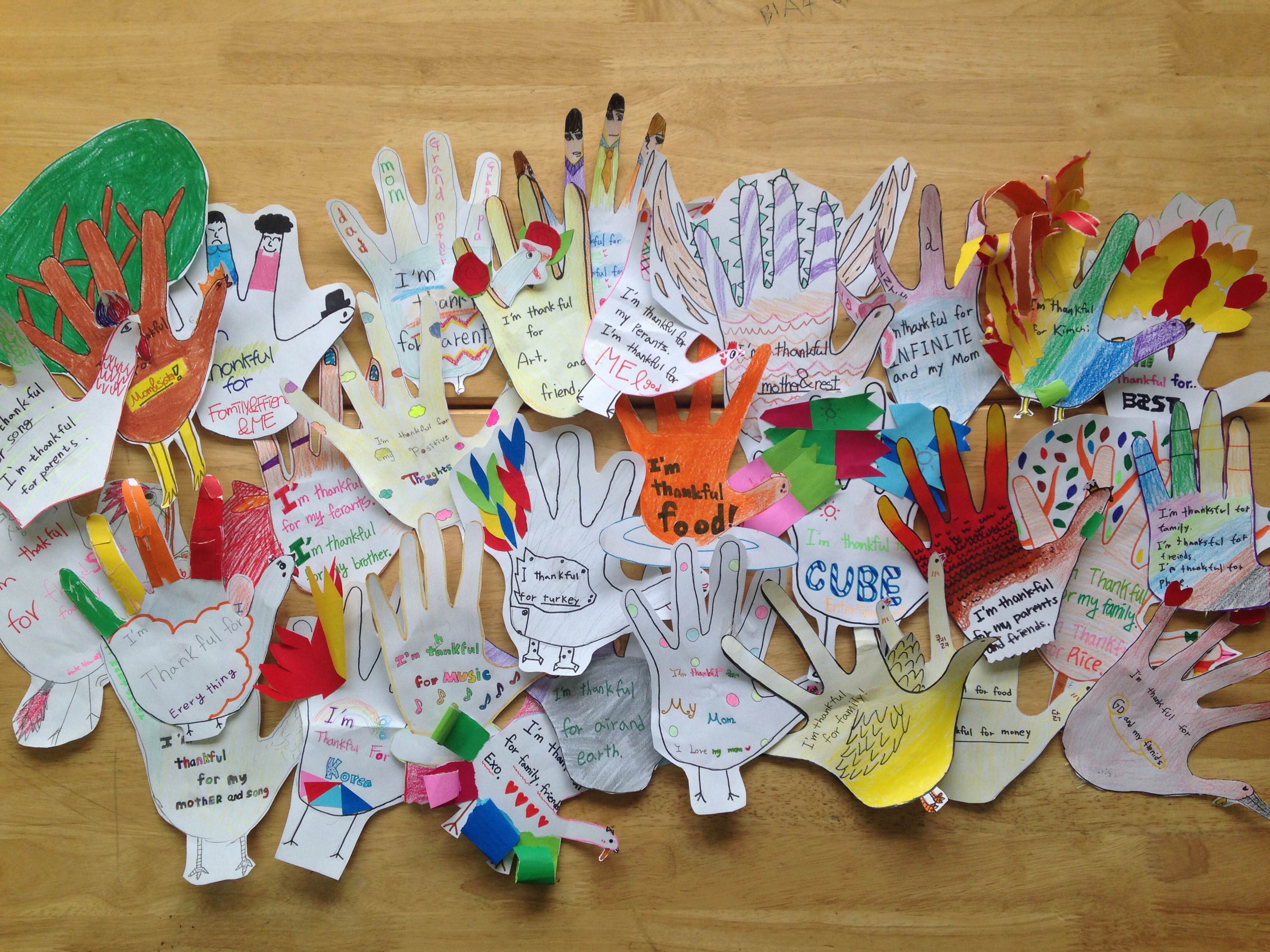
My Korean students’ hand turkeys. Assignment was to write what they were most thankful for. 🙂 Click image to view more closely, then click again to zoom! 


Well, it’s that time of year when teachers and parents look for books that celebrate Thanksgiving. Ultimately, Thanksgiving in the United States is a holiday to give thanks, eat copious amounts of food and spend time with family. The history of the holiday however is very much sugar coated and this is evident in a lot of Thanksgiving children’s literature…

If diverse literature is necessary for our children’s growth, we must be sure to let diverse voices speak, and speak clearly and true.

Most people don’t even know that the Pilgrims interacted with Wampanoag Indians. People just know about “Pilgrims and Indians.” There is rarely any discussion about what happened after the sharing of food (broken treaties, take-over of land, violence and disease). Some people think that children are too young to know the real history but I beg to differ; almost any topic can be brought to a level that children can understand and handle. The relationship between the Pilgrims and Wampanoag involved understanding and protection. There were treaties, agreements and opportunities for celebration. The Wampanoag taught the Pilgrims how to harvest and survive on their land. The first “Thanksgiving” as we’ve come to call it, happened in 1621 and was a result of the Pilgrims shooting off guns to celebrate a successful harvest. Wampanoag leader Massasoit sent warriors to check out the ruckus but realized they were just celebrating, so he and his men joined in on the celebrations, hunted and brought food.

Perhaps many teachers are anxiously waiting to see their students dressed up as Pilgrims and Indians but please keep in mind that 1) There is a long and problematic history of “playing Indian” and cultural appropriation in our country’s history 2) dressing up as Native peoples reinforces the idea that Native people are only in the past; most people in the U.S. can’t name any contemporary Native American activists, musicians, writers, actors, lawmakers, etc. Also, many children’s books don’t bother to accurately illustrate the regalia (not costumes) of Wampanoag people; any old “Indian outfit” will do as long as it is cute. Representation is important.

Listed below is one really cool book and several GREAT links and resources for your consideration this Thanksgiving season.

Happy Thanksgiving! Gobble Gobble!


1621: A New Look at Thanksgiving (I Am American) by Catherine O’Neil Grace and Margaret M. Bruchac, 2004 National Geographic Children’s Books, ISBN: 9780792261391

American Indian Perspectives on Thanksgiving– Really great resource from the Smithsonian National Museum of the American Indian

The Real History of Thanksgiving Teacher’s Guide– History Channel Resource

Best Thanksgiving Books for Children– Good list of books

Are You Teaching the Real Story of the “First Thanksgiving?”– Great Education World article

What Really Happened on the First Thanksgiving? -Indian Country Today Media Network Article

Oyate.com Thanksgiving article and book list

The Stories Julian Tells

StoriesJulianTells

Image Credit: Bullseye Books (Alfred A. Knopf), Ann Cameron/Ann Strugnell

The Stories Julian Tells is fantastic. It’s a story full of poetic lines, vibrant imagery and is simply magical. It opens with Julian and Huey’s father making a lemon pudding for their mother; you’ve never seen such enthusiastic cooking! He says “Leave the pudding alone!” and then almost instantly falls asleep on a chair. His boys disobey of course, one taste leads to another and before they know it, the whole pudding is gone! The Stories Julian Tells features several interconnected stories that showcase Julian’s fantastic stories, his brother Huey’s imagination, their parents’ love for them and friendship. I love the Catalog Cats! Who knew invisible cats help your garden grow?

StoryJulianTells2

New Cover…cute but I’m partial to the original

This short novel is an excellent example of a story that features a family of color but doesn’t focus on the fact that they are a family of color and is not “historical.” They’re just a super cool Black family in the 80s! Perhaps many readers grew up with this book and love it. Ann Strugnell’s illustrations are magical and suit the story perfectly. Newer editions have an “updated” cover but I really love the original. The Stories Julian Tells is a great read aloud book and is also good for the classroom; so many discussions to be had about Julian and Huey and their fabulous stories.


Recommended for: 1st Grade and up
Great for: Diversity, Fantasy, Friendship, Morals, Discussion, Family, Read-Aloud, African-American
Book Info: The Stories Julian Tells by Ann Cameron/Illustrated by Ann Strugnell, 1989 Random House Books for Young Readers, ISBN: 9780394828923

So Much

Image Credit: Candlewick Press, Trish Cooke/Helen Oxenbury

Image Credit: Candlewick Press, Trish Cooke/Helen Oxenbury

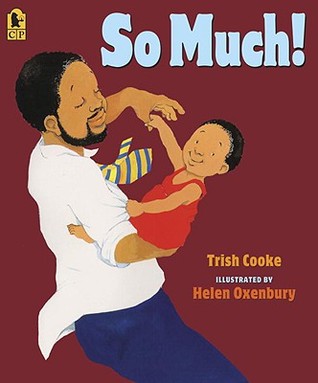
My mother found this book for me at a thrift store and I’m so grateful she did! Trish Cooke is Afro-Caribbean from the UK and not only does the book show a loving family of color but she uses Afro-Caribbean English to write the story. I also really like her book Full, Full, Full of Love. The beginning of So Much has a nice rhythm that’s great for little ones to follow. Another thing I love about this book is that it’s illustrated by the great Helen Oxenbury.  Oxenbury and Cooke create a lovable story about a little baby and his family that loves him SO MUCH.

So Much begin with the baby sitting with his mom, simply enjoying the day, then the doorbell rings and another member of the family arrives. Each time someone new comes, they say they want to squeeze the baby, kiss the baby, so much! The father comes home tired from work to a house full of love.  There are some negative reviews online for this book’s “bad grammar.” I don’t think those reviewers took the time to research the author’s background or simply didn’t care. I love the addition of Afro-Caribbean English because 1). It is different and 2). Cooke is sharing her culture with her readers.

Oxenbury’s gouache illustrations are lovely; her paintings depict movement and joy and love. I especially love the pages where the family is crowded together, dancing and having a good time because it reminds me of my family. I also love how 90s the illustrations are; there are lots of sneakers, baggy shirts, caps and funky prints (This book was first printed in 1994!). In the author/illustrator notes at the back of the book, Oxenbury says that this book was the first time she had to illustrate only humans (none of her signature animals at all) and that it was a challenge. I think she did an excellent job and if you look closely, the baby’s teddy bear has great expressions! I think you will enjoy this book so much!

Recommended for: Toddlers and up
Great for: Family, Diversity, Cultural Diversity,
Book Info: So Much by Trish Cooke/Illustrated by Helen Oxenbury, 1997 Candlewick Press, ISBN: 9780763602963
*Note– This book is possibly out of print. If you can’t find it at a bookstore, check at your local library, used bookstores and online.

Exciting News! Diverse Book Flyer

I woke up this morning to some super exciting news. We Need Diverse Books is teaming up with Scholastic Reading Club to produce a special book club flyer featuring more than 75 diverse books!!   🙂 🙂

This is more of what we need. Book fairs and book clubs are the first opportunity for many kids to own books; especially if they are from low income neighborhoods. Many people don’t realize how going to a bookstore can be a luxury for many families. This collaboration is a big step towards getting these books into the hands of children who need them!  I’m extremely excited about the potential this collaboration has to spread awareness of the diverse titles that are already out there.

I also really hope the list of books includes good Native American books because that demographic is largely overlooked and underrepresented. I can already think of two good ones for the target age of this project (4th-8th grade): Eagle Song and On This Long Journey, the Journal of Jesse Smoke, a Cherokee Boy, the Trail of Tears, 1838, by Joseph Bruchac.

Follow this link to read more about this announcement! Parents and teachers, keep an eye out for the book flyer coming to your schools soon.

Update: Click here for a PDF of the book flyer! Check out all the great titles!

Hiawatha and the Peacemaker

Image Credit: Abrams, Robbie Robertson/David Shannon

Image Credit: Abrams, Robbie Robertson/David Shannon

November is Native American Heritage Month and to kick off the month right, I’m paying homage to a place that’s special to me. I attended Cornell University in Ithaca, NY and the campus sits on Cayuga land. The Cayuga are one of the Six Nations of the Haudenosaunee (Iroquois Confederacy). I learned a lot from Haudenosaunee people and I love their land (it is gorges up there). So the first book I’ll review to celebrate this month is an AMAZING new picture book called Hiawatha and the Peacemaker by Robbie Robertson and illustrated by David Shannon.

This book tells the story of how the warring nations of the Haudnosaunee came together in peace. Hiawatha is a sad man with anger in his heart because the evil Onondaga Chief Tadadaho killed his wife and children; he is hell-bent on revenge. One day, a man called the Peacemaker comes and tells Hiawatha that he needs him to carry his message of Peace, Power and Righteousness to all the nations. Hiawatha has to look inside himself to realize the power of forgiveness.

This story will be familiar to some readers and brand new to most but what shines about this book is not only its powerful message, but that it’s by a Native American author (Robertson is Mohawk and Cayuga) and Shannon’s oil paintings are beautiful. There are many books about Native peoples by non-Native authors; some are well researched and are respectful but many are not. Robertson tells his people’s story and that in and of itself gives power to this book. David Shannon worked with Robertson to create bold illustrations that carry the power of the story. They are so very strong. This book will appeal to artists, lovers of Native Studies and history, and any child or adult who craves a great story.

Recommended for: All ages, especially 4th grade and up
Great for: History, Native American Heritage Month, Cultural Diversity, Discussion, We Need Diverse Books
Book Info: Hiawatha and the Peacemaker by Robbie Robertson/Illustrated by David Shannon, 2015 Abrams, ISBN: 9781419712203

Cakes in Space

Image Credit: Random House, Philip Reeve/Sarah McIntyre

Image Credit: Random House, Philip Reeve/Sarah McIntyre

Who doesn’t want to read a book about monster cakes in space?? Who could pass up a funky cover like this? Cakes in Space is FUN, snarky, totally ridiculous and a great story. This book is a stand-alone but it’s also the second in the Not-So-Impossible Tale Series by the amazing team, Philip Reeve and Sarah McIntyre. Their first book, Oliver and the Seawigs, is also awesome.

The book opens with Astra and her family heading to the new planet of Nova Mundi which is 199 years away. Before they’re locked into their pods for hibernation, Astra’s rumbling belly leads her to the ship’s “Nom-a-tron” to get a snack. She asks for the ultimate cake. The machine takes an unusually long time to process her request so she goes back to her pod to hibernate. Unfortunately the machine takes her request too literally and…MAKES CAKES THAT ARE ALIVE!! Astra wakes from her hibernation before everyone else, but 99 years have passed and the cakes have had 99 years to evolve and have taken over the ship! She has to fight the cakes and along the way she makes new friends, trusts her gut and uses her smarts.

McIntyre’s sci-fi illustrations are very cute and inviting. She only uses a few colors; orange, black, brown and gray and it works surprisingly well. This book is a mix between a picture book and a chapter book because there’s an illustration on just about every page. If you have a child who is a little trepidatious about jumping into larger chapter books, this is a great bridge for them because it isn’t too long and it has lots of pictures! It’s also one of my recommended read-aloud books for families.

Recommended for: 2nd Graders and up, Children ready for longer chapter books
Great for: Friendship, Sci-fi, Action/Adventure, Girl Power, Read-Aloud, Diversity
Book Info: Cakes in Space by Philip Reeve/Illustrated by Sarah McIntyre, 2014 Random House, ISBN: 9780385387927

Ten, Nine, Eight

Image Credit: Tupelo Books (HarperCollins), Molly Bang

Image Credit: Tupelo Books (HarperCollins), Molly Bang

While browsing the web, I saw the cover of this book and immediately had flashbacks. I’m a very visual person and the last time I’d seen this cover was when I very little. I’d completely forgotten about this book, and so, I set out to find it.

Molly Bang covers a lot of important basics here; love, family, counting and warm illustrations. Her oil illustrations really shine and you can’t help but smile while looking at them. The cover illustration is very reminiscent of Goodnight Moon in composition. I especially recommend this book in board book form because it is the perfect size for toddlers to hold. Formulaic, descriptive lines like “Ten small toes all washed and warm” create a comfortable feeling and little ones will enjoy going to bed with this book.

We see a black father loving his child. This is important because it isn’t depicted often, in all types of media. This little book celebrates their love for each other. Regardless of ethnicity, the father-daughter relationship is underrepresented in picture books (but luckily that is changing). Ten, Nine, Eight is a great book for counting, vocabulary and bedtime and it just happens to feature a beautiful, black family.  🙂

Recommended for: Toddlers
Great for: Counting, Vocabulary, Bedtime, Family, Diversity, We Need Diverse Books, Father-Daughter, African-American
Book Info: Ten, Nine, Eight by Molly Bang, 1983 Tupelo Books (HarperCollins), ISBN: 9780688149017

Respect My Canon! (Please)

Image Credit: American Girl

Image Credit: American Girl, http://www.americangirl.com

I didn’t grow up reading classics that may be a part of your personal canon. I wasn’t very interested in books like Little House on the Prairie or Ramona the Brave because I had my trusty Berenstain Bears books AND several books that featured little black girls. I connected to those images unconsciously. Naturally, content was the most important thing to me in a book, but how could I not want to see someone like me? A black girl doing cool things?! Yeah, let’s read about that! [Shout out to the American Girl, Addy]

Mufaro’s Beautiful Daughters was one of my favorites growing up and still is; click here to read my post about it. My father was very Afrocentric, so I had many books about Africa and Black History on my bookshelf. I went to a mostly African-American Catholic elementary school and was lucky enough to have as my second grade teacher Mrs. Reid, who taught us about Black History. I distinctly remember the day we learned “We Shall Overcome.” This is where I come from. So I often wonder why it’s “expected” that I’ve read certain western children’s classics, especially in my personal reading time, as a child. I respect the western children’s classics but I don’t necessarily relate to them.

I’m just asking you to respect my canon. It is powerful too. More importantly, respect the fact that many children of color have a hard time connecting to what they read. Every child is different. Some kids, you throw any book at them and they’ll devour it. Other kids have to find that one perfect book they can relate to, that lights a spark for them. These kids might see a positive representation of themselves in a book and think quietly, “Oh hey, I can do that too?” and then they’re off. That’s all it takes. So guess what we need? MORE of these books. Let’s encourage these books in order to support these authors to get these stories out there for our children.