Mission to Space

missiontospace

Image Credit: White Dog Press (Chickasaw Press), John Herrington

Native American Heritage Month just ended here in the U.S. with constant reports of aggression and violence towards Native peoples at Oceti Sakowin Camp. Snow has fallen on the camp and the water protectors are still standing strong against the Dakota Access Pipeline. I’ve noticed, through media coverage of this situation, that visibility of Native peoples has risen somewhat. When children see Native people standing strong and united against a pipeline that will affect all of us, that helps fight ignorance & combats racism. Stereotypes of Native people are still very pervasive and harmful.

Contemporary stories about Native people, especially written by Native people, are important “mirror” books for Native children who simply don’t see enough of themselves in books. These stories are also vital tools in classrooms full of non-Native children. That’s why Mission to Space is so important; it’s a non-fiction book, written by Chickasaw astronaut John Herrington, printed by Chickasaw Press. Author Zetta Elliott often talks about the importance of community-based publishing and this is a perfect example.

mission-to-space2

Image Credit: White Dog Press (Chickasaw Press), John Herrington

In Mission to Space, Commander John Herrington takes us back to his roots as a boy who loved shooting rockets with his dad and brother. Years later, he’d grow up to be an astronaut on the shuttle Endeavor! In this book, simple but effective text is accompanied by vivid photographs. Herrington explains how much work it takes to do something well and in his case, to become an astronaut. That’s an important lesson for children. When he was launched into space, people from his nation came to celebrate; he was the first tribally-enrolled Native person to fly in space!

Children who love science, astronomy and languages will get a lot out of this book. Not only does Herrington give readers a behind-the-scenes look into what it takes to become an astronaut, he talks about how important language is for Chickasaw identity and provides a glossary of space terms in the Chickasaw language. I hope you’ll check this book out!

P.S. Visit the book’s website to see a cool video and take a look at Debbie Reese’s glowing review.


Recommended for: All Ages
Great for: Astronomy, Determination, Dreams, Role Models, STEM, Language, Native American, Chickasaw, Sovereignty, Native American Heritage Month, Family, Discussion
Book Info: Mission to Space by John Herrington, 2016 White Dog Press (Chickasaw Press), ISBN: 9781935684473


Lift Your Light a Little Higher

liftyourlightalittlehigher

Image Credit: A Caitlyn Dlouhy Book (Atheneum Books for Young Readers (Simon & Schuster)), Heather Henson/Bryan Collier

Because of slavery, we simply don’t know as much as we should about extraordinary Africans in the Americas. But luckily, in this renaissance of children’s literature, we’re getting some amazing books about slavery & slaves’ lives, written by #ownvoices and by non-PoC. Two great ones that come to mind are Etched in Clay by the late Andrea Cheng & Freedom in Congo Square by Carole Boston Weatherford & Gregory Christie.

I’ve been reflecting on slave stories and slavery for several reasons. One; I recently had the pleasure of hearing Ta-Nehesi Coates speak about the lasting effects of slavery on the fabric of America. Two; the other day, someone asked me about children’s books that are helpful for easing into a discussion about slavery with a white child. While it’s very understandable to want to shield your child from the horrors of slavery, it’s quite a position of privilege to be able to. Black children don’t have that privilege. That being said…there are several books that introduce slavery from a position of humanity and hope. Lift Your Light a Little Higher is one of those books.

Stephen Bishop was extraordinary. He was an adventurous cave-explorer and guide who happened to be enslaved. As a tour guide of the Mammoth Caves in Kentucky, he had a great sense of pride and agency; underground was his world. He was incredibly knowledgeable of the cave’s winding trails & dangerous chasms and he even discovered new creatures! Lift Your Light a Little Higher takes us back to around 1840 and is in first person; Stephen leads the reader on a journey while reflecting on his life, enslavement and legacy. Though he’s proud of being known far and wide, he says “…being known is not the same as being free.” When it comes down to it, he’s still a slave. He longs to read and write and eventually leaves his mark on stone for all to see; an assertion of his power.

Henson does a great job of using known information about Stephen to create a book that honors his spirit and voice. She lifted her light to shine on Stephen, creating a book that, I think, he would be proud of. I interpret this book as Henson telling his story while simultaneously telling the reader about her journey to uncover his story; lines like “sometimes you just got to go beyond what’s written down to get to what’s been left untold” suggest this. I also like how she comments on indigenous peoples’ presence in the caves and on the land. Stephen is aware, as a black, enslaved man, that he is on indigenous land and contemplates his legacy.


liftyourlight2

Image Credit: A Caitlyn Dlouhy Book (Atheneum Books for Young Readers (Simon & Schuster)), Heather Henson/Bryan Collier

Collier’s art is, as usual, powerful and creative. His collages takes us deep inside the dark and mysterious caverns. Stephen’s big brown eyes and confident expression visually show us his strength. Collier uses many beautiful shades of brown to create the peaceful interior of the caves that Stephen found respite within. I always really enjoy Collier’s art; there’s so much depth to it.

Before reading this book, I didn’t know Stephen Bishop and now I do (and so will many children). When I travel down to Mammoth Caves, I’ll look for him and while in his space, I’ll think of him and the legacy he left for all to see. He was of the shadows but shone brightly! People of color always find a way to persevere despite oppression; part of his rebellion was his determination to learn and leave his mark as…S-T-E-P-H-E-N.

This book is sure to create lots of important conversation in classrooms and households about black history. I especially hope that it’s being used in Kentucky classrooms!

 
P.S. Be sure to also check out Heather Henson’s book, That Book Woman; it’s one of my favorites. Also click here to learn a little more about black history at Mammoth Caves.


Recommended for: 1st grade and up
Great for: Role Models, Inner Strength, African American, U.S .History, Black History, Determination, Slavery, Slave Narratives, Family, Curiosity, Kentucky
Book Info: Lift Your Light a Little Higher: The Story of Stephen-Bishop: Slave Explorer by Heather Henson/Illustrated by Bryan Collier, 2016 A Caitlyn Dlouhy Book (Atheneum Books for Young Readers (Simon & Schuster)), ISBN: 9781481420952

We Sang You Home

wesangyouhome

Image Credit: Orca Book Publishers, Richard Van Camp/Julie Flett

We’re about half-way through Native American Heritage Month 2016 and almost a week into a world where Donald J. Trump is the President-Elect of the United States of America…I’ve been reflecting and thinking a lot about peace, love and family. I’ve also been thinking about kindness and doing my best to share books that celebrate open-mindedness, different perspectives, cultures and #ownvoices. I can’t praise this one enough.

If you’re looking for a great book that celebrates the joy and wonder of having a child, look no further. We Sang You Home is beautifully written and illustrated. We’re slowly getting more books about Native families created by Native people but we need more. As a bookseller and blogger, I can’t wait for these stories! I want to share them and most importantly, Native kids need to see more of themselves on bookshelves.

In We Sang You Home, a Native couple tells their child how they wished and dreamed for him and how his arrival changes their lives. They are better for having him. “We sang you from a wish. We sang you from a prayer. We sang you home and you sang back.” A child holds its parents hopes, dreams and wishes. Van Camp writes beautifully and in the short format of a board book, tells a story of happiness. We’re reminded that a child chooses its family just as much as a family wishes for it; it’s magic.

Julie Flett is a great illustrator; I always enjoy reading and reviewing her books! In this one, she depicts the sweetness of Van Camp’s words with warm earth colors, sunsets & moonshine, toothy smiles and brown skin. Flat, blocks of color fill the pages. The simpler the better for board books and this one is simply beautiful.

I hope you’ll pick it up for Native American Heritage Month and enjoy it throughout the year! 🙂


P.S. Check out Debbie Reese’s beautiful review here.


Recommended for: All Ages
Great for: Celebration, Diversity, Love, Family, Happiness, Indigenous Peoples, Native Heritage Month, New Baby
Book Info: We Sang You Home by Richard Van Camp/Illustrated by Julie Flett, 2016 Orca Book Publishers, ISBN: 9781459811782

Music Is…

musicis

Image Credit: Simon Kids (Simon & Schuster), Brandon Stosuy/Amy Martin

I’m not a big fan of music. I know that sounds weird. I mean, I enjoy listening to music. Of course there are songs that take me back; the memories connected to those songs are so vivid. I always dance and move to a good song or beat. I’m just not INTO music. Some people live and breathe it; they always have headphones on and bump it loud in their car. They talk music, they anticipate music, they live music.

That’s not me but I appreciate music and I love how happily this book celebrates it.

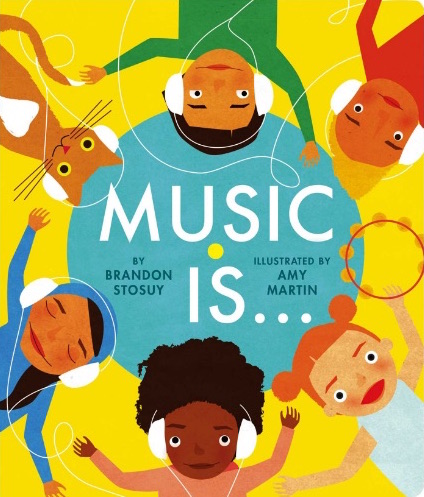
Music Is…has flowing text that begins simply, becomes more lyrical and ends reflectively. Contrasting words like quiet & loud, slow & fast, lo-fi & hi-fi lead to lines like “cymbals that splash and ba-da-ba bass and rat-a-tat-tat drums on a rumbling stage.” Stosuy’s words are great for reading aloud and invite discussion. “How is music happy?” “What is lo-fi?” “What does ‘Music is for everyone’ mean?” are just a few questions that children might ask when reading this book and for that reason, it’s a book for all ages! Music-loving parents will want this book to share with their children.

musicis2

Image Credit: Simon Kids (Simon & Schuster), Brandon Stosuy/Amy Martin


Amy Martin’s illustrations are bold, eye-catching and so diverse. I love how she uses colors that contrast and highlight. Her art shows children that indeed, music is for everyone. Her illustrations match the rhythm of Stosuy’s words and the cover of the book is so bright and inviting!

I hope you’ll check this one out. It’s a pretty cool board book to share and enjoy. 🙂


Recommended for: All Ages
Great for: Music, Music History, Diversity, Family, Emotions, Friendship, Relationships, Vocabulary, Humor
Book Info: Music Is… by Brandon Stosuy/Illustrated by Amy Martin, 2016 Little Simon (Simon & Schuster), ISBN: 9781481477024

Let’s Celebrate Diwali

letscelebratediwali

Image Credit: Bharat Babies (Mascot Books), Anjali Joshi/Tim Palin


It’s almost Diwali, the festival of lights, so why not celebrate with this cool picture book!? 🙂

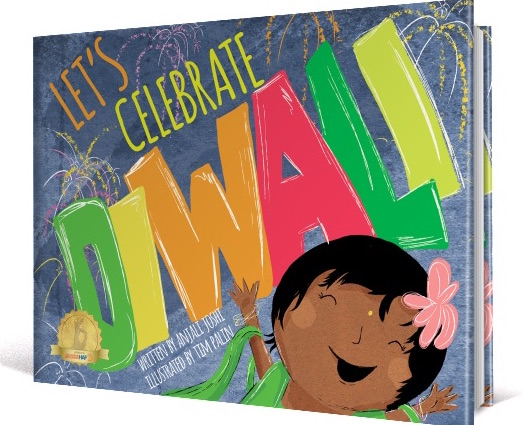
Let’s Celebrate Diwali tells the story of Harini and her friends. These four friends are in the same classroom and on Diwali, they share their Diwali stories. Harini is Hindu, Dhimen is Buddhist, Urvi is Jain and Amrit is Sikh. Dressed in traditional outfits, they take turns telling how they celebrate the holiday and readers learn how rich Diwali is. It’s important that their teacher, Ms. Lo, gives her students the ability to share their cultures and religions during circle time. Her classroom is a safe and welcoming space for all religions and cultures which is something children need to see and experience.

Harini and Urvi learn that they both light diyas for Diwali but the stories their families tell are different. This book does a great job of highlighting cultural diversity and respect; all the students in the classroom are engaged during circle time and ask great questions. At the end of the story, Anna, who does not celebrate Diwali, wishes for a special Diwali outfit too and Harini lets her wear her dupatta (scarf) and bangles. Harini races home and can’t wait to share the new Diwali stories she learned at school. Maybe readers will be inspired to learn more about the stories featured in this book!

I love the addition of a pronunciation guide + definitions of the vocabulary in the text. Anjali Joshi’s cute and relatable story is one that children will connect to and learn a lot from. I enjoyed Tim Palin’s vibrant and happy illustrations. I especially like the design of the cover; the bright, blocky letters mimic the bright lights and exciting fireworks of Diwali. The round faces of the children in the book are warm and inviting.

Here is a cute Paper Diya craft from blogger Artsy Craftsy Mom that pairs well with this book.  Just like Harani and Urvi, you’ll have diyas in your home this Diwali.


Happy Diwali! ❤


Recommended for: All Ages
Great for: Holidays, Cultural Relativity, Cultural Diversity, India, Diwali, Friendship, Community, School Life, Family, Respect, Religion, Celebration
Book Info: Let’s Celebrate Diwali by Anjali Joshi/Illustrated by Tim Palin, 2016 Bharat Babies (Mascot Books), ISBN: 9781631774218

I Am Not a Number

iamnotanumber

Image Credit: Second Story Press, Jenny Kay Dupuis & Kathy Kacer/Gillian Newland

“Meta” picture books have their place, cute bunnies, princesses and dragons in picture books have their place too. But there’s no denying the power of a non-fiction narrative to teach. I Am Not a Number teaches about an often overlooked and ignored part of the history of Native peoples in the Americas; the history of boarding/residential schools and the pain associated with settler colonialism.

In I Am Not a Number, Anishinaabe/Ojibway (Nipissing First Nation) author and educator Dr. Jenny Kay Dupuis shares her grandmother’s story. With the help of author Kathy Kacer, Dupuis takes a tough and emotional subject and creates a learning tool. This book can also help First Nations children and families with healing and bringing forward stories of trauma. The emotional control and abuse afflicted upon children by Christian missionaries and the government has had lasting effects on First Nations communities. Some of the more well known examples of detrimental residential boarding school systems are in Australia, Canada and the United States. Here in the United States, Capt. Richard H. Pratt, founder of the Carlisle School, said that instead of killing “The Indian” one must “kill the Indian in him, and save the man.” Generations of Indigenous people around the world have suffered emotional trauma under states determined to “civilize” them.

iamnotanumber2

Image Credit: Second Story Press, Jenny Kay Dupuis & Kathy Kacer/Gillian Newland


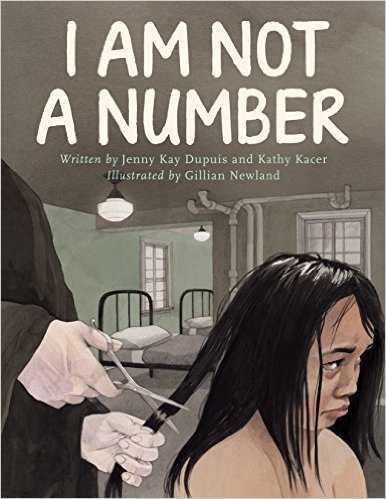
I Am Not a Number begins on the Nipissing Reserve Number 10 in Ontario, Canada and follows young Irene as she’s forced to leave her home with two of her bothers. The Indian agent represents the law and Irene’s parents must send their children to residential school with him. Irene doesn’t know what awaits her but holds her mother’s words “Never forget who you are!” close. As the title of the book suggests, the children are stripped of the basic right of a name at the school; numbers are what the nuns refer to them by. They’re also beaten (and worse) for speaking their language. I Am Not a Number does not shy away from the gritty details of abuse in residential schools. This transparency is necessary for telling these stories. When summer finally comes, Irene and her brothers are allowed to go home for a while and the familiarity of their food, land and family are like a balm. Even speaking her language feel strange, though, and she suffers nightmares. Irene’s parents make the decision to fight to keep their children, no matter the consequences!

I’m glad for the back ground information at the end of the book about Canadian residential schools and especially Jenny Kay Dupuis’ afterword about her grandmother, Irene Couchie Dupuis. In addition to powerful storytelling, this book has moving and beautiful illustrations. Using a palette of grays, browns and greens, Gillian Newland brings Irene’s experience (and strength) to life for the reader. The images in this book don’t directly portray physical abuse but they show the aftermath in fearful, stunned and pained expressions. She also does a great job of portraying love; my favorite spread is of Irene and her father, forehead to forehead, eyes locked and comforting. Relieved to be reunited.

This is an important book that I hope you’ll take the time to experience with your children. Children’s non-fiction picture books are powerful and necessary for teaching history, empathy and respect. Thanks for sharing your grandmother’s story, Jenny Kay Dupuis!


Recommended for: 2nd Grade and up
Great for: Strength, Friendship, Indigenous Peoples, Boarding Schools, Family, Love, Resilience, Determination, Community, Canadian History, Colonialism, Emotional Trauma, Religion, Social Justice, Social Issues
Book Info: I Am Not a Number by Jenny Kay Dupuis and Kathy Kacer/Illustrated by Gillian Newland, 2016 Second Story Press, ISBN: 9781927583944

Celebrating Our Grandmothers

print_cover_fishing_sized_eng

Image Credit: Inhabit Media Inc., Susan Avingaq & Maren Vsetula/Charlene Chua

dontcallmegrandma

Image Credit: Carolrhoda Books (Lerner Publishing Group), Vaunda Micheaux Nelson/ Elizabeth Zunon

Today I’m doing a double review of two excellent books that explore relationships with grandmothers. Fishing with Grandma and Don’t Call Me Grandma are very different stories that feature loving and powerful grandmothers.

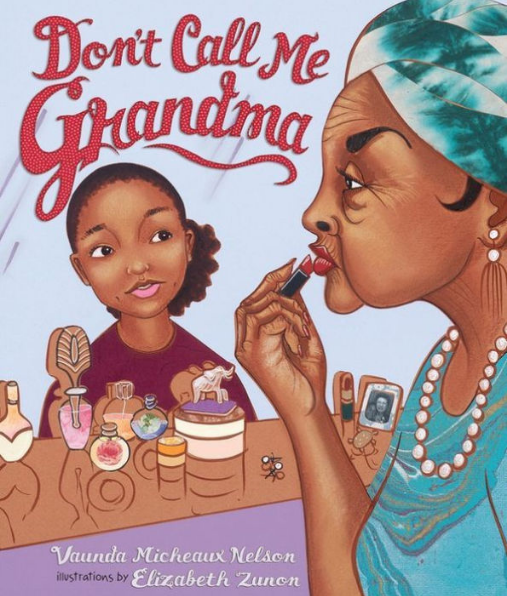
Don’t Call Me Grandma wasn’t what I expected it to be. From reading the title alone, I assumed it would be about a grandmother who doesn’t want to be reminded of her age but that’s not what it’s about at all! Vaunda Micheaux Nelson writes really great books by the way; I’ve already reviewed The Book Itch and Bad News for Outlaws. This book tells the story of a little girl and her relationship with her glamorous Great-Grandmother Nell. Great-Grandmother Nell has a strong personality; she’s very prickly but is also loving (in her own way). Nell’s great-granddaughter is slightly scared of her but because she knows how special she is, she works hard to get close to her.

I really enjoyed the flashbacks scenes in this book because they tell us more about Great-Grandmother Nell. The scene about Nell’s first heart-break is very moving, though it’s not the kind of heart-break you might expect. Great-Grandmother Nell is ninety six  years old and has lived through the civil rights movement and more. I’m glad to see this story discuss race and being a Colored girl (and later a Colored woman) in the United States.

dont-call-me-grandma2

Image Credit: Carolrhoda Books (Lerner Publishing Group), Vaunda Micheaux Nelson/Elizabeth Zunon

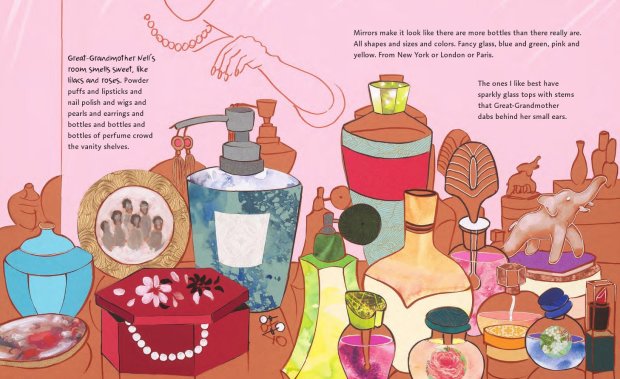
Elizabeth Zunon’s illustrations are beautiful. Her style is a mix of watercolor, pen, markers, collage and pencil. Great-granddaughter favors Great-Grandmother and Great-Grandmother’s warm brown face is full of rich lines and wrinkles. All the beautiful perfume bottles on her vanity and the scene where she teaches her great-granddaughter how to blot her lipstick reminds me of my grandmother. For the flashback scenes, Zunon uses blotchy watercolors that give the feeling of hazy memory. Check out this behind the scenes blog post about how Zunon created the illustrations!

Great-Grandmother Nell is a strong grandmother and so is Anaanatsiaq (grandmother) in Fishing with Grandma. She drives an ATV and is always down for an adventure! In the story, a little boy and girl are excited to visit their favorite elder. Their visit starts with string games and fresh bannock from the oven but the children are eager for a little more adventure. They decide to go jigging for fish on the ice and Anaanatsiaq shows them how to dress for the cold. She also shows them to how to check the ice for thickness (safety first) and how to use traditional tools!

One of my favorite things about this book is that it’s full of Inuktitut words and describes Inuit fishing tools. Children can learn a bit of another language while enjoying a story about a loving indigenous family. Another plus is that the story is co-written by Inuit elder Susan Avingaq…so it’s a story about indigenous peoples written by an indigenous woman for children all over the world. This is the power of #ownvoices.

After the family has a successful day of fishing, Anaanatsiaq explains that the extra fish they caught will go to elders who can’t make it out to the lake. It’s important to give and think of others and also important to learn traditional skills, she says. These are good lessons for children all over the world to take away.

fishing-with-grandma2

Image Credit: Inhabit Media Inc., Susan Avingaq & Maren Vsetula/Charlene Chua

Charlene Chua’s digital illustrations are so clean and vibrant. I love how she brings their community to life and I especially like the spreads on the blue ice and underwater with the beautiful Arctic char. I like how she uses streaks of color to fill space; it creates a pretty effect. Her characters have such bright expressions and rosy cheeks! Annanatsiaq is loving and protective of her curious grandchildren; her happy face shows a lot of pride. They’re adventurers just like her!

I hope your family will take time to enjoy these two stories about grandmothers. Maybe you can even read them with your grandmothers!

Recommended for: All Ages
Great for: Family, Grandmothers, Relationships, Teamwork, Ice Fishing, Siblings, Love, Indigenous Peoples, Community, Diversity, Strong Women
Book Info: Fishing with Grandma by Susan Avingaq & Maren Vsetula/Illustrated by Charlene Chua, 2016 Inhabit Media Inc., ISBN: 9781772270846

Recommended for: All Ages
Great for: Family, Grandmothers, Racism, History, Relationships, African American, Strong Women, Patience, Understanding
Book Info: Don’t Call Me Grandma by Vaunda Micheaux Nelson/Illustrated by Elizabeth Zunon, 2016 Carolrhoda Books (Lerner Publishing Group), ISBN: 9781467742085

A Piece of Home

APieceofHOme copy

Image Credit: Candlewick Press, Jeri Watts/Hyewon Yum

Creating a new ordinary.

Not everyone wants to stand out, especially if your family moves to a new country and you suddenly feel different from everyone else. Hee Jun is a self proclaimed “ordinary” Korean boy and his grandmother is a highly respected teacher in Korea…until Hee Jun’s father gets a job in West Virginia and everything changes. Hee Jun’s family goes through a roller coaster of emotions until they find comfort and familiarity in their new lives.

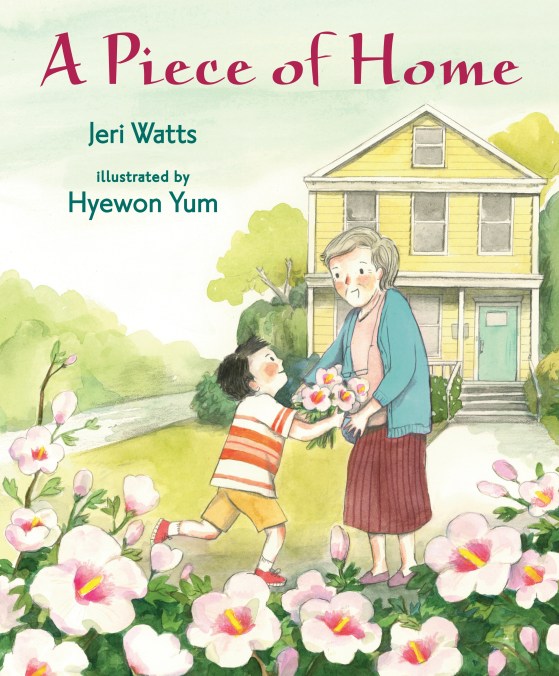
Jeri Watts does a great job of depicting Korean culture and children’s emotions during times of change. This story was inspired by a Korean student who desperately wanted her to understand him and felt out of place in his new home of Virginia. As great as her storytelling is, the book wouldn’t be what it is without Hyewon Yum’s authentic voice coming through in the art. From the first page, I felt like I was back on the side streets surrounding my 초등학교 (elementary school). My school had a 떡볶이 (spicy rice cake) shop across the street just like the high school Hee Jun’s grandmother teaches at. I love how Yum incorporates Korean words and sentences into the illustrations. Her art is evocative and she’s great at characterization and creating story.

APieceofHome2

Image Credit: Candlewick Press, Jeri Watts/Hyewon Yum

I really connected to this book because (as you can probably guess) I used to live in Korea. I graduated from college and almost immediately flew over to start a new life as an English teacher. Similar to Hee Jun, I felt out of control and confused at times. He also reminds me of my students, especially the ones who wanted to get to know me but didn’t have confidence in their ability to communicate with me. I made them feel uncomfortable in their own space, which must’ve been nerve-wracking! The world caters to native English speakers but Native English speaking countries rarely cater to non-native English speakers! >_< Like Hee Jun’s grandmother, immigrants bring richness into the United States that shouldn’t be ignored just because they struggle with English.

The other day I snapped this photo of 무궁화 (Mugungwha/Rose of Sharon) growing near my house. It made me think of my city of 대구 and my friends and students there.
Mugunghwa

I hope you enjoy A Piece of Home as much as I did. I think a lot of children will be able to relate to it!


Recommended for: All Ages
Great for: Family, Community, Immigration, Friendship, Korea, Korean Culture, Inner Strength, Difference, School Life, Diversity, Discussion, Language, Confidence
Book Info: A Piece of Home by Jeri Watts/Illustrated by Hyewon Yum, 2016 Candlewick Press, ISBN: 9780763669713

Puffy: People Whose Hair Defies Gravity

Puffy

Image Credit: CreateSpace, Aya de León

Black hair texture varies and because many of us are blended, it comes in every form imaginable. People of African origin naturally have a coarser hair type and our hair is often seen as unkempt, not beautiful and unprofessional. We can also be the toughest critics of our natural hair and therefore it’s SO important that children with “puffy” hair see positive images of themselves.

This picture book is a celebration of puffy hair in every magnificent form on various shades of skin. While reading Aya de León’s rhyming text and seeing the joyful photographs, readers will delight in the diversity of natural hair. Puffy isn’t just about hair, it’s about vibrancy and pride in oneself.

Representation matters and I would’ve loved this book as a child. My peers had a lot to say about my dreadlocks (“Are you a boy or a girl??”) and reading a book with people who looked like me in it would’ve been empowering! This unabashedly happy book is needed; it’s already difficult enough to find shining brown faces on book covers and this one is a welcome addition to every library.

I hope you’ll enjoy Puffy: people whose hair defies gravity! #CareFreeBlackKids


Recommended for: All Ages
Great for: Family, Friendship, Pride, Hair, Black Hair, Empowerment, Diversity, Black Girls Rock, Identity, Encouragement, Read-Aloud
Book Info: Puffy: people whose hair defies gravity by Aya de León, 2013 CreateSpace, ISBN: 9781494436773

Have You Seen Elephant?

HaveYouSeenElephant

Image Credit: Gecko Press USA (Gecko Press Ltd), David Barrow

I finally got my hands on this book, y’all!  I spotted it on Twitter months ago and it’s finally available in the US. *victory*

Do you know how refreshing it is to open a picture book that’s obviously about an interracial family…but doesn’t focus on it? We’re starting to see more books like this (The Airport Book) in children’s literature. Don’t get me wrong; books that focus on race are necessary but it’s also important to have ones that present multiculturalism as norm. The endpapers & first page of the book show a wall of family photographs that tell us a bit about the family’s genealogy.

In Have You Seen Elephant?, a boy is invited to play a thrilling game of hide and seek. Elephant kindly warns him that he’s very good. He’s up for the challenge though and it turns out that Elephant is rather good. My goodness, Elephant is in the most obvious places but no one sees him. 😉 After they finish their game, Turtle asks if they want to play tag…he’s quite speedy.

HaveYouSeenElephantExtra

Image Credit: Gecko Press USA (Gecko Press Ltd), David Barrow

I like this book very much. Not only is it very sweet, it’s playful, hopeful and kind. They’re all very good friends and care about each other. The text is sparse but it allows the illustrations to speak loudly. Children can fill in the gaps and decide for themselves whether Elephant is really good at hiding or if the boy and his family are very generous. Barrow’s illustrations are heartwarming; he uses lots of warm browns, golds, oranges and reds. There’s a lot of texture in his technique; spirals radiate out from light sources and scratches, splotches and drips are on every page.

I think you’re going to really enjoy this book. I can’t wait to see what’s next from David Barrow!

P.S. Pay attention to the endpapers for laughs. 😀


Recommended for: All Ages
Great for: Family, Friendship, Animals, Love, Diversity, Multiculturalism, Discussion, Read-Aloud, Humor
Book Info: Have You Seen Elephant? by David Barrow, 2016 Gecko Press USA (Gecko Press Ltd), ISBN: 9781776570089