The Tree in the Courtyard: Looking Through Anne Frank’s Window

TheTreeintheCourtyard

Image Credit: Alfred A. Knopf (Penguin Random House), Jeff Gottesfeld/Peter McCarty

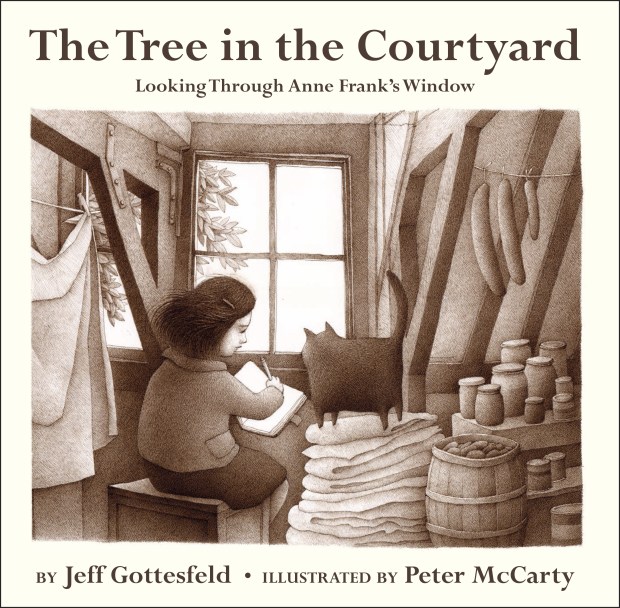
In her diary, Anne Frank tells us about a beautiful chestnut tree that grew outside of her window. This book imagines the events of Anne’s life through the tree’s lens and while doing so, we are reminded of the shock of loss and the horrors of war.

In The Tree in the Courtyard, a horse chestnut tree grows to love the young Anne Frank for her vivacious spirit. Jeff Gottesfeld gives us a very unique perspective of a very familiar and tragic moment in history. The story is very moving; when I walked away from this book, I couldn’t help but think two things 1) Anne Frank was a beautiful writer 2) What a great way to honor her spirit and help children learn not only about history but also about compassion and perspective.

The tree never fully understands exactly why war is happening but it feels and knows the effects of it (much like a child, perhaps). As it grows steadily, it connects to Anne and the occupants of the annex. It likes to watch Anne get lost in her writing and makes sure to blossom beautiful for her. But one day the occupants of the annex are suddenly taken away and only Anne’s father comes back, visibly changed. The tree is distraught. As years pass, other people occupy the annex but the tree finds irony in the fact that people put more love into its care than they did for Anne’s well-being. The symbolism of the chestnut’s saplings spreading around the world and living on, like Anne’s words, is powerful.

Peter McCarty’s illustrations fill the pages in a warm, beautiful brown. The shortened bodies with large heads and expressive faces, deep shadows and hatch marks are signature McCarty. I especially love how he illustrates Anne with her dark, soulful eyes and wispy hair and I love how he gives life to the tree; its limbs seem to stretch lovingly towards Anne and the annex. On the pages that depict soldiers and air raids, straight lines with white space are drawn harshly (like sharp blasts) while on other pages, the lines are softer and ultimately more comforting.

This picture book will surely encourage young readers to learn more about Anne. I hope teachers and parents will use this book to not only discuss Anne Frank, WWII and the Holocaust but to also teach the importance of compassion, love and hope.


Recommended for: 1st-2nd Grade and Up
Great for: Reflection, Inspiration, Brilliance, Discussion, History, Family, Relationships, Hope, Love, Peace, Judaism, World War II, Nazi Occupied Netherlands, Holocaust, Tragedy, Resilience, Anne Frank, Perspective
Book Info: The Tree in the Courtyard: Looking Through Anne Frank’s Window by Jeff Gottesfeld/Illustrated by Peter McCarty, 2016 Alfred A. Knopf (Penguin Random House), ISBN: 9780385753975

My Heart Fills With Happiness

MyHeartFillsWithHappiness

Image Credit: Orca Book Publishers, Monique Gray Smith/Julie Flett

I’m so glad to finally read this little book! Board book format is perfect for this story because it’s meant to be handled, loved and explored. My Heart Fills With Happiness is a much needed depiction of modern Native families; children’s publishing doesn’t have enough and I’m excited to welcome this story!

The families in this book are so happy and loving. Simple sentences accompany an illustration; children can study the art and work towards reading on their own. This story will evoke memories and inspire new memory-making in your family. Sometimes the simplest things put a smile on your face and make your heart full.

Julie Flett! I’ve already reviewed Wild Berries; I’ve expressed my love for her illustrations and once again, she’s created beautiful images to cherish. Her art paired with Monique Gray Smith’s lovely words (the font is also perfect!) is beautiful. This is a great new book to add to your collection and I hope it’ll be well loved alongside all your chewed up and cherished board books. 🙂


Recommended for: Babies, Toddlers, Early Readers
Great for: Family, Relationships, Siblings, Love, Everyday Life, Read-Aloud, Native Families, Nature, Happiness, Diversity, Cultural Diversity, Discussion, Vocabulary
Book Info: My Heart Fills With Happiness by Monique Gray Smith/Illustrated by Julie Flett, 2016 Orca Book Publishers, ISBN: 9781554987290

When the Slave Esperança Garcia Wrote a Letter

EsperancaGarcia

Image Credit: House of Anansi Press (Groundwood Books), Sonia Rosa/Luciana Justiniani Hees

Women’s History Month is wrapping up and I’m going to officially end it on my blog by sharing the story of this strong black woman.

Esperança Garcia was an enslaved Afro-Brazilian woman, a mother, a wife and a writer. The author opens the book with the hope that the world will know her story and know her strength. Esperança’s family was enslaved by Jesuit priests but when the priests were expelled from Portugal and its colonies, her family was split apart. Under the Jesuits, though enslaved, she learned to read and write. At this time, very few women at all had this skill. Unfortunately, her life with her new owner was worse than with the Jesuits; she and her young children were regularly beaten and mistreated.

Esperança devoured books and knowledge because they gave her joy. But the more she read, the angrier she became about the injustices of slavery. With this passion for change in her heart, she decided she’d write a letter to the governor to tell about her suffering and ask for his help in sending her home to reunite with her family.  She also explained her dismay at not being able to baptize her young daughter. She carried on loving her children and working, toiling and waiting anxiously for a reply…Esperança was the first slave to write a letter of petition in Afro-Brazillian Brazil.

EsperancaGarcia2

Image Credit: House of Anansi Press (Groundwood Books), Sonia Rosa/Luciana Justiniani Hees

The writing of this book is gorgeous. This woman’s story deserves powerful illustrations and luckily, Luciana Justiniani Hees’ art goes above and beyond. I love how she draws Esperança and the slaves with their blue/black/purple skin and strong faces. Esperança’s cornrowed hair and features are beautiful. The colors Hees’ uses are so deeply vibrant and comforting despite the heavy subject matter of the book. My favorite spread is where Esperança rests in the slave quarters, body propped up and head rested on her hand as her children sleep beside her.

I’d never heard of this woman until now and I’m glad to know her. Thank you to Brazilian author and illustrator Sonia Rosa and Luciana Justiniani Hees and Groundwood books for publishing this book in North America. Check out When the Slave Esperança Garcia Wrote a Letter, discuss deeply and share her story. What is Women’s History Month if not an opportunity to learn about (and be reminded of) the strength of women?


Recommended for: 2nd Grade and up
Great for: Afro-Brazilian, Brazil, Piauí, Black History, Slavery, Injustice, Black Girl Magic, Family, Community, Cultural Diversity, Diversity, Defiance, Determination, Inner Strength, Resistance, Education, Discussion, Religion, Non-Fiction, Biography
Book Info: When the Slave Esperança Garcia Wrote a Letter by Sonia Rosa/Illustrated by Luciana Justiniani Hees, 2015 House of Anansi Press (Groundwood Books), ISBN: 9781554987290

Shining Star: The Anna May Wong Story

ShiningStar

Image Credit: Lee & Low Books Inc., Paula Yoo/Lin Wang

Whenever I see photograph of Anna May Wong…SLAY QUEEN, SLAY!   >_<

Anna May Wong grew up in LA washing clothes in her parents laundry and healing from the hateful slurs from her white peers at school. She started skipping school to watch actors on movie sets and was inspired to act. Though she was discouraged by her parents (good Chinese girls didn’t act), as a teenager she won a role as an extra in a film (her dad allowed it because they needed the money). She did extra roles for years until her first big role in Bits of Life in 1921. She played the wife of a Chinese man (White actor in yellowface) but they could’t kiss because it was against the law. She was disturbed by the yellowface but pressed on for the money and experience.

ShiningStar2

Image Credit: Lee & Low Books Inc., Paula Yoo/Lin Wang

She’d continue to rise but her roles were very stereotypical and demeaning of Asian women. Anna May moved to Europe and achieved fame there but when she came back, hoping to score the lead role in The Good Earth, they gave it to…a white actress. She was fed up with discrimination and was caught between her desire to resist the racist roles AND follow her dream of acting in the US. During a trip China (she faced some criticism there for accepting stereotypical roles) to learn more about her heritage and to visit her retired parents, her spirt was renewed. Her father reminded her to always be proud of her race and fight to respectfully represent her people. She’d continue to act, but only in non-stereotypical Asian roles!

Lin Wang’s watercolor and acrylic illustrations are gorgeous. I just LOVE the way Yoo and Wang open the book; the illustration of the train rushing towards Anna May is extremely dramatic and dynamic! Wang really brings to life the glamour and grace of Anna May Wong.

What a good book! Anna May Wong isn’t as well known as she should be…The efforts she made towards improving the representation of Asian Americans in film isn’t as well known as it should be. With the current state of diversity in the film industry (not enough has changed), it’s especially important to go back and learn about those who’ve paved the way!


Recommended for: 2nd grade and up
Great for: Determination, Confidence, Girl Power, Role Model, Women’s History Month, Acting, Film Industry, Discrimination, Racism, Stereotypes, Ant-Miscegenation Laws, Diversity, Cultural Relativism, History, Film History, Asian American, Chinese American, Dreams, Family, Relationships, Discussion, Biography, Non-Fiction
Book Info: Shining Star: The Anna May Wong Story by Paula Yoo/Illustrated by Lin Wang, 2009 Lee & Low Books, ISBN: 9781600602597

Alphablock

Alphablock

Image Credit: Abrams Appleseed (Abrams), Christopher Franceschelli/Peskimo

Quality design is important. Eye-catching graphics and clever construction can set a book apart from the rest.

Alphablock is a dynamic board book. Along with Take Away the A, this is one of my favorite ABC books. With its chunky build and interactive pages, it’s perfect for learning and discovering! The first page gets right down to it, flip the letter A and you’ll learn that A is for…Apple. The A blends into the page before it and we’re presented with a scene (a picnic).

Alphablock2

Image Credit: Abrams Appleseed (Abrams), Christopher Franceschelli/Peskimo

Alphablock is great for storytelling. What’s going on? Why do you think they’re having a picnic? What other fruits are on the page and so on. Parents and teachers can use this book in many ways to work on reading, vocabulary and word-picture association. Peskimo’s digital illustrations are bold and fabulous. Hope you’ll pick up this one and explore the alphabet.


Recommended for: Babies, Toddlers, Early Readers
Great for: ABC, Early Childhood Development, Word Picture Association, Interactive, Animals, Foods, Vocabulary, Early Learning, Discussion
Book Info: Alphablock by Christopher Franceschelli/Illustrated by Peskimo, 2013 Abrams Appleseed (Abrams), ISBN: 9781419709364

Josephine: The Dazzling Life of Josephine Baker

Josephine

Image Credit: Chronicle Books, Patricia Hruby Powell/Christian Robinson

A passionate woman full of energy, charisma and magic was Josephine Baker.

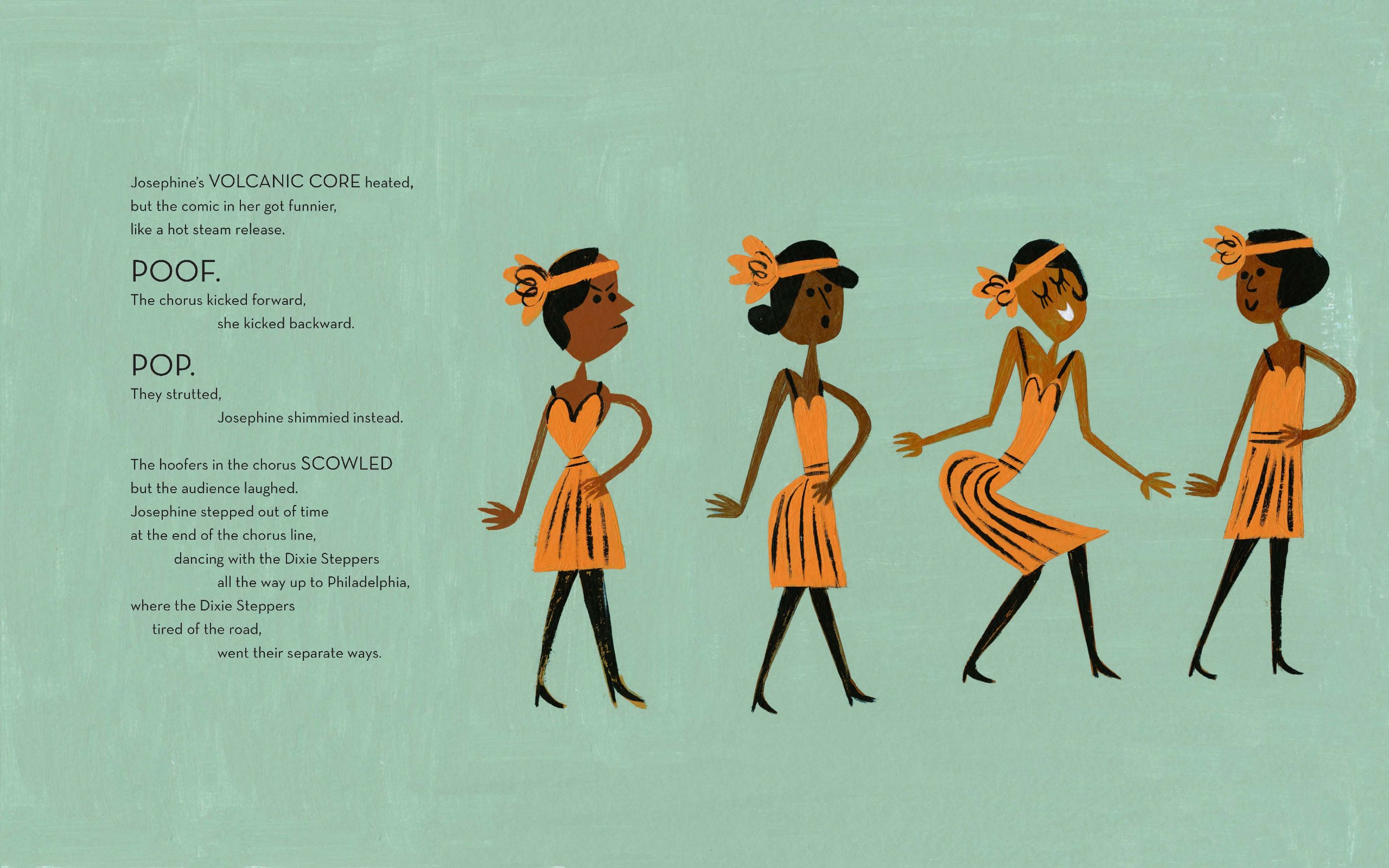
Patricia Hruby Powell uses the metaphor of volcano to describe Josephine’s personality and I think this is perfect. Ever since a little girl, she bubbled and popped and fizzled with pent up energy to perform and dance. She was born poor in segregated St. Louis to a single mother who also loved to dance. They shared a love of vaudeville. As a child she started out in the group The Jones Family but quickly moved on to The Dixie Steppers. Even in a chorus line she stood out with her distinct, silly style. She got hitched, went to broadway and used her smarts to get onstage and SHINE.

Look how spunky and charming she is in the film Zouzou (1934)!

Though she loved to perform, Josephine was tired of segregation and just barely getting by. She got the chance to head to Paris where as soon as she stepped off the steam ship, she wasn’t discriminated against because of her color and felt truly beautiful! She took Paris by storm, charming the entire city, headlining shows, staring in movies and drawing crowds with her energy and risqué banana skirts. She was in every way fabulous, scandalous and daring. When war came she spied for France and became a hero.

As she got older, she remarried and adopted twelve children from all over the world; her rainbow tribe. Though she worked hard to support her children and keep up her lavish lifestyle, she was put out of their mansion, the bills too much to pay. Luckily her friends helped her family and years later, at sixty-seven years old, she decided to give the US one more try. It was a success! America loved her and dear Josephine danced herself to eternal sleep.

Josephine2

Image Credit: Chronicle Books, Patricia Hruby Powell/Christian Robinson

The rhythm and energy of the writing in this book suits Josephine’s personality. It’s broken very cleverly into “acts” of her life. Robinson’s illustrations, as usual, are vivid and beautiful. His signature long bodied figures are perfect for Josephine’s limber body. The book opens with a red curtain, each “act” is introduced by a scene on a stage and finally, after we finish reading the story, the red curtain returns, flowers stewn on the floor below it. I love this touch. It brings the story full circle; she lived for performance. Robinson says in the end notes that he’s been connected to Josephine Baker’s story ever since he was young and it’s very evident in the loving way he depicts her.

Josephine has become one of my favorite biography picture books. It’s one that my bookstore never carried and I kept reading about online. I kept thinking “I’ve GOT to read that book!” After reading Josephine (or maybe even during, like I did), you’ll want to look up photographs and videos of this AMAZING woman. What a woman she was…


Recommended for: 2nd grade and up
Great for: Dance, Vaudeville, African-American, Segregation, Determination, Black Girls Rock, Black Girl Magic, Confidence, Courage, Rhythm, Energy, Paris, Black History Month, Black History Month Children’s Books, Non-Fiction, Discussion, Biography
Book Info: Josephine: The Dazzling Life of Josephine Baker by Patricia Hruby Powell/Illustrated by Christian Robinson, 2014 Chronicle Books, ISBN: 9781452103143

Follow the Drinking Gourd

FollowtheDrinkingGourd

Image Credit: Dragonfly Books (Random House), Jeanette Winter

This classic from my childhood discusses the importance of allies on the road to freedom. Abolitionists helped fearless slaves free themselves from oppression. Peg Leg Joe, the abolitionist featured in this story, may or may not have been a real person but the Underground Railroad was definitely real.

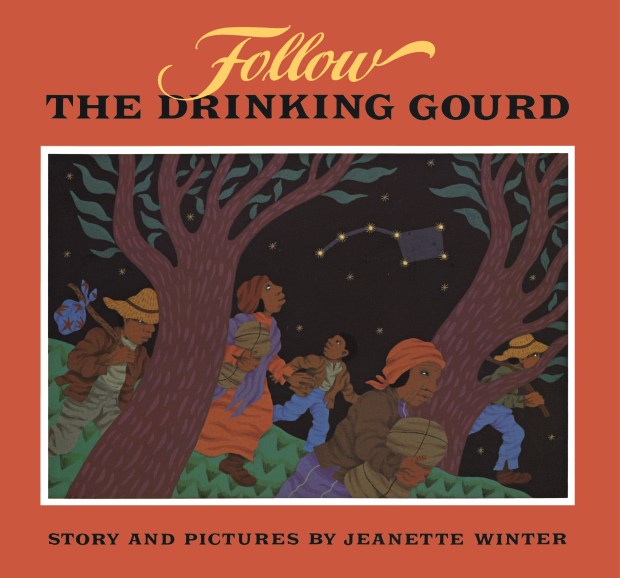
In Follow the Drinking Gourd, Peg Leg Joe  works at cotton plantations with the sole purpose of teaching slaves his song, Follow the Drinking Gourd, which tells them how to get to freedom. One day, Molly’s husband James is sold to another master and they have only one more night together. Slaves often had their families suddenly torn apart in this way. But that night they hear a quail’s song, the first clue from the song to get moving towards freedom. They decide to make an escape.

FollowtheDrinkingGourd2

Image Credit: Dragonfly Books (Random House), Jeanette Winter

The family follows the Drinking Gourd (Big Dipper), remembering the lines of Peg Leg Joe’s song for guidance. They hide from hounds and look for signs that they’re heading in the right direction; North. They get help from farmers and finally meet up with Peg Leg Joe who takes them across the Ohio River to their next stop, the house of a white family. They keep moving from house to house and take time to rest and heal and even stay at the place of a free black man. The family finally makes it to Canada, to freedom.

This has always been one of my favorite books about slavery because it presents it in a clear, easy to understand way. Children who have no understanding of slavery will need some explanation as to why the family wants to escape. There are no happy slaves here; we see the family’s hesitation, worry, fear and finally joy and relief. Jeanette Winter’s illustrations are extremely moving; especially the one with James on the auction block, head down and distraught, “Negroes for Sale” below him. I read this book quite often when I was young, so much so that the images are still very familiar to me. Be sure to check it out and discuss! The complete song is included on the last page.


Recommended for: 1st grade and up
Great for: Slavery, Underground Railroad, African American, Injustice, Inner Strength, Fearlessness, Determination, Family, Relationships, Allies, Abolitionism, Astronomy, Black History Month, Black History Month Children’s Books, Non-Fiction, Discussion
Book Info: Follow the Drinking Gourd by Jeanette Winter, 1992 Dragonfly Books (Random House), ISBN: 9780679819974

Martin de Porres: The Rose in the Desert

MartindePorres

Image Credit: Clarion Books (Houghton Mifflin Harcourt), Gary D. Schmidt/David Diaz

Martin de Porres was born to an African/Native slave mother and a Spanish nobleman father in the barrios of Lima, Peru. The priest of a cathedral reluctantly baptized him, not knowing or caring that Martin would grow to be a true man of God. Martin lived with his mother and sister in poverty until he was 8 years old when his father came and took them to Ecuador. Martin came back to Lima to be an apprentice to a surgeon (a cirujano) and excelled at it.

Because he was African, people were prejudiced towards him but his skills were obvious. He was gifted lemon seeds for helping a man and after planting them, the next day a tree grew. At fifteen he wanted to become a priest but was denied the opportunity due to his mixed-blood. He offered to clean, wash and care for the monastery instead. People started to notice his gift with animals and his amazing healing powers. He performed miracles. Everyone, from the poor to the rich, came to him when in need. After many years of service he was allowed to become a priest, was finally seen as a brother, and continued his good deeds until his death.

MartindePorres2

Image Credit: Clarion Books (Houghton Mifflin Harcourt), Gary D. Schmidt/David Diaz

The illustrations are absolutely gorgeous and soft. I also love Diaz’ work in Wilma Unlimited. He has a very distinct style. My favorite spread shows Martin blissfully surrounded by a horse, chickens, mice and dogs. They all show their love and appreciation for him and he gives it back just as much.

To his mother, Martin was always a Rose in the Desert but finally, despite his brown skin and heritage, he was seen as the true rose he was, by everyone. Martin de Porres was beatified in 1837 and finally canonized in 1962. He is the first black saint in the Americas! How fitting this caring and spiritual man of color be named the patron saint of brotherhood, those of mixed race, animal shelters, interracial relations and social justice!

I like finding unique stories. I’m glad to be able to share this one with you for Black History Month. 🙂


Recommended for: 1st grade and up
Great for: Catholicism, Saints, Miracles, Mixed-Race, Injustice, Discrimination, Peru, Helping Others, Animals, Community Service, Love, Black History Month, Black History Month Children’s Books, Non-Fiction, Discussion, Biography
Book Info: Martin de Porres: The Rose in the Desert by Gary D. Schmidt/Illustrated by David Diaz, 2012 Clarion Books (Houghton Mifflin Harcourt), ISBN: 9780547612188


Skit-Scat Raggedy Cat Ella Fitzgerald

SkitScatRaggedyCatElla

Image Credit: Candlewick Press, Roxanne Orgill/Sean Qualls

Ummm hmm. Ella’s voice is one of my all time favorites. What I like about this picture book is that it tells the story of her early life, when she was just a Raggedy Cat trying to survive.

Ella had a larger than life personality ever since she was a young girl. Growing up in Yonkers, NY, her family didn’t have much but they had plenty of music.  Her voice could draw a crowd. She and her friend Charlie learned the newest moves and made a little change on the sidewalks dancing for crowds. It was a time of Jazz Jazz Jazz. Her mother passed away suddenly and she ended up on 145th Street in Harlem, living with her aunt. She didn’t get much love there so she searched for something better, on her own.

https://dailymotion.com/video/xl2uy

Ella’s 1938 chart0topper “A Tisket A Tasket” which was included in a movie called Ride ‘Em Cowboy in 1942. Oh look she’s at the back of the bus!  >_<

She got into some trouble and found herself in a school for orphans. They beat the girls, especially the black girls, so she ran away, back to Harlem. She was on the streets and in and out of people’s homes but one day she heard about auditioning at the Apollo Theater and decided to give it a try. The crowd almost ran her off the stage but the emcee gave her another chance and she blew them away! Ella started to make a name for herself. Despite her plain looks, bandleader Chick Webb gave her a chance to join his band at the Savoy. Ella’s spirit shone through her voice, loud and clear. People loved dancing to her. The band got their first big hit when she wrote “A Tisket, A Tasket.” With that song she shot to stardom and didn’t have to worry about food, lack of nice clothes and a place to sleep ever again!

I like Sean Qualls’ art style. He likes to lay his acrylic down a little rough and scratchy and uses a palette of reds, oranges, blues and browns. I love the jazz scenes that show the vibrance of Harlem at its artistic peak. Author Roxane Orgill and Sean Qualls really did an excellent job of pairing story with illustration; when I finished the book, I felt satisfied. I learned so much about young Ella and her spirit.

If you’re looking for an excellent biography that celebrates never giving up despite the odds, check out Skit-Scat Raggedy Cat…and go listen to some jazz!


Recommended for: 1st Grade and up
Great for:  Jazz, Jazz Bands, Music History, History, African-American, Black Girls Rock, Black Girl Magic, Inner Strength, Family, Determination, Discrimination, Jim Crow, Apollo Theater, Harlem, Dance, Black History Month, Black History Month Children’s Books, Non-fiction, Discussion, Biography
Book Info: Skit-Scat Raggedy Cat Ella Fitzgerald by Roxane Orgill/Illustrated by Sean Qualls, 2010 Candlewick Press, ISBN: 9780763617332

Brick by Brick

BrickbyBrick

Image Credit: Amistad (HarperCollins), Charles R. Smith Jr./Floyd Cooper

This book is a tribute to the slaves who built the White House, a building never meant for their Black Bodies…but yet!

The writing of Brick by Brick is beautiful. Charles R. Smith Jr. plays with the word “hand” by focusing on the slaves’ hands while describing their position as hands, as workers. Slave hands, white hands and free black hands worked together but slave hands did the most of the hard work to build the original White House for John Adams. They hauled stone, laid brick and sawed through logs with blistered, tired, bleeding hands. They suffered while their slave owners took the money earned.

Yet, as oppressed people do, they survived, thrived and learned. As the White House came to completion, slaves were taught new skills to finish the fine interior work of the house. With these new skills, they were able to save money and work towards paying for their freedom. Brick by brick they built the massive structure but they also built a way out of enslavement. I love how Charles R. Smith Jr. works NAMES into the story. We read and speak aloud the names of these amazing people. By including the actual names of slaves who worked on the White House, he brings them to life for us and honors them.

Cooper’s illustrations, as usual, are skilled and moving. He depicts the slaves’ warm dark brown skin, strong hands and raw expression beautifully. For another example of his beautiful work, check out Ruth and the Green BookBrick by Brick‘s words and illustrations create a portrait of the people who built one of the most important buildings in our country. The White House is a symbol of “freedom” yet it was built by the hands of those who were not free. This book is excellent for sparking discussion and is important because it covers a part of history that may not be very well known. Enjoy this book, read the Author’s Note and talk, talk, talk!


Recommended for: 2nd grade and up
Great for:  Toil, Pain, African-American, Family, History, Slavery, Injustice, Rhythm, Rhyme, Read-Aloud, White House History, Black History Month, Black History Month Children’s Books, Non-fiction, Discussion
Book Info: Brick by Brick by Charles R. Smith Jr./Illustrated by Floyd Cooper, 2013 Amistad (HarperCollins), ISBN: 9780061920820