So Much

Image Credit: Candlewick Press, Trish Cooke/Helen Oxenbury

Image Credit: Candlewick Press, Trish Cooke/Helen Oxenbury

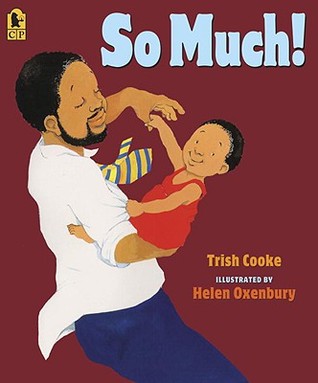
My mother found this book for me at a thrift store and I’m so grateful she did! Trish Cooke is Afro-Caribbean from the UK and not only does the book show a loving family of color but she uses Afro-Caribbean English to write the story. I also really like her book Full, Full, Full of Love. The beginning of So Much has a nice rhythm that’s great for little ones to follow. Another thing I love about this book is that it’s illustrated by the great Helen Oxenbury.  Oxenbury and Cooke create a lovable story about a little baby and his family that loves him SO MUCH.

So Much begin with the baby sitting with his mom, simply enjoying the day, then the doorbell rings and another member of the family arrives. Each time someone new comes, they say they want to squeeze the baby, kiss the baby, so much! The father comes home tired from work to a house full of love.  There are some negative reviews online for this book’s “bad grammar.” I don’t think those reviewers took the time to research the author’s background or simply didn’t care. I love the addition of Afro-Caribbean English because 1). It is different and 2). Cooke is sharing her culture with her readers.

Oxenbury’s gouache illustrations are lovely; her paintings depict movement and joy and love. I especially love the pages where the family is crowded together, dancing and having a good time because it reminds me of my family. I also love how 90s the illustrations are; there are lots of sneakers, baggy shirts, caps and funky prints (This book was first printed in 1994!). In the author/illustrator notes at the back of the book, Oxenbury says that this book was the first time she had to illustrate only humans (none of her signature animals at all) and that it was a challenge. I think she did an excellent job and if you look closely, the baby’s teddy bear has great expressions! I think you will enjoy this book so much!

Recommended for: Toddlers and up
Great for: Family, Diversity, Cultural Diversity,
Book Info: So Much by Trish Cooke/Illustrated by Helen Oxenbury, 1997 Candlewick Press, ISBN: 9780763602963
*Note– This book is possibly out of print. If you can’t find it at a bookstore, check at your local library, used bookstores and online.

Exciting News! Diverse Book Flyer

I woke up this morning to some super exciting news. We Need Diverse Books is teaming up with Scholastic Reading Club to produce a special book club flyer featuring more than 75 diverse books!!   🙂 🙂

This is more of what we need. Book fairs and book clubs are the first opportunity for many kids to own books; especially if they are from low income neighborhoods. Many people don’t realize how going to a bookstore can be a luxury for many families. This collaboration is a big step towards getting these books into the hands of children who need them!  I’m extremely excited about the potential this collaboration has to spread awareness of the diverse titles that are already out there.

I also really hope the list of books includes good Native American books because that demographic is largely overlooked and underrepresented. I can already think of two good ones for the target age of this project (4th-8th grade): Eagle Song and On This Long Journey, the Journal of Jesse Smoke, a Cherokee Boy, the Trail of Tears, 1838, by Joseph Bruchac.

Follow this link to read more about this announcement! Parents and teachers, keep an eye out for the book flyer coming to your schools soon.

Update: Click here for a PDF of the book flyer! Check out all the great titles!

Hiawatha and the Peacemaker

Image Credit: Abrams, Robbie Robertson/David Shannon

Image Credit: Abrams, Robbie Robertson/David Shannon

November is Native American Heritage Month and to kick off the month right, I’m paying homage to a place that’s special to me. I attended Cornell University in Ithaca, NY and the campus sits on Cayuga land. The Cayuga are one of the Six Nations of the Haudenosaunee (Iroquois Confederacy). I learned a lot from Haudenosaunee people and I love their land (it is gorges up there). So the first book I’ll review to celebrate this month is an AMAZING new picture book called Hiawatha and the Peacemaker by Robbie Robertson and illustrated by David Shannon.

This book tells the story of how the warring nations of the Haudnosaunee came together in peace. Hiawatha is a sad man with anger in his heart because the evil Onondaga Chief Tadadaho killed his wife and children; he is hell-bent on revenge. One day, a man called the Peacemaker comes and tells Hiawatha that he needs him to carry his message of Peace, Power and Righteousness to all the nations. Hiawatha has to look inside himself to realize the power of forgiveness.

This story will be familiar to some readers and brand new to most but what shines about this book is not only its powerful message, but that it’s by a Native American author (Robertson is Mohawk and Cayuga) and Shannon’s oil paintings are beautiful. There are many books about Native peoples by non-Native authors; some are well researched and are respectful but many are not. Robertson tells his people’s story and that in and of itself gives power to this book. David Shannon worked with Robertson to create bold illustrations that carry the power of the story. They are so very strong. This book will appeal to artists, lovers of Native Studies and history, and any child or adult who craves a great story.

Recommended for: All ages, especially 4th grade and up
Great for: History, Native American Heritage Month, Cultural Diversity, Discussion, We Need Diverse Books
Book Info: Hiawatha and the Peacemaker by Robbie Robertson/Illustrated by David Shannon, 2015 Abrams, ISBN: 9781419712203

Mufaro’s Beautiful Daughters

Image Credit: Lothrop, Lee & Shepard Books, John Steptoe

Image Credit: Lothrop, Lee & Shepard Books, John Steptoe

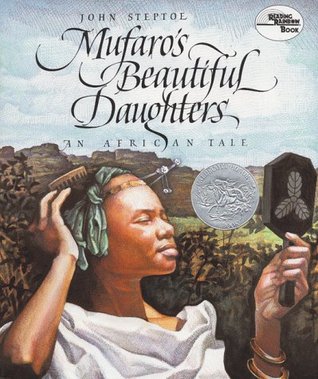
Can we just take a moment to admire how beautiful the cover is? It’s easy to see why this book won a 1988 Caldecott Honor Award. This is one of my absolute favorite books from my childhood because it was one of the first books in which I saw a reflection of myself. Look at that beautiful black girl on the front!

Author/illustrator John Steptoe created this African-Cinderella story after being inspired by African folktales published in a collection called Kaffir Folktales by G.M. Theal in 1895. Theal was a South African historian who also felt it was his duty as a Christian White male to civilize the Africans. So from African roots to colonization to a Black artist living in Brooklyn, these stories traveled and inspired. Steptoe created a book that celebrates Africa. He uses water soluble inks applied by brush and pen and with this technique, his illustrations glow. They are so beautifully vibrant!

In Mufaro’s Beautiful Daughters, Mufaro has two daughters named Manyara and Nyasha. Manyara is a rotten person and treats her humble and kind sister Nyasha horribly. One day it’s announced that the Great King is looking for a new wife and only the most worthy woman will become his Queen. Manyara’s selfishness catches up with her and Nyasha’s gentle nature and kindness give her all the treasures she deserves. This twist on the western Cinderella tale is very sweet and is full of morals for people of all ages to learn from. If you have a child who loves Cinderella stories, add this one to their collection! You’ll enjoy reading it together.

Recommended for: All ages
Great for: Fairytales, Cultural Diversity, Diversity, Morals, History, Discussion
Book Info: Mufaro’s Beautiful Daughters by John Steptoe, 1987 Lothrop, Lee & Shepard Books, ISBN: 9780688040451

Bee-bim Bop!

Image Credit: Sandpiper: Houghton Mifflin Harcourt, Linda Sue Park

Image Credit: Sandpiper: Houghton Mifflin Harcourt, Linda Sue Park/Ho Baek Lee

Linda Sue Park’s sweet, lyrical Bee-bim Bop! follows a family making a traditional Korean dish and is a great story time book. It’s also an excellent cultural book for younger readers (especially toddlers).  Bibimbap is one of the most well known Korean dishes in the United States and this book brings the cooking process to life.

Bibimbap

Two delicious types of bibimbap (비빔밥)

Bee-bim Bop! is close to my heart because it reminds me of my life in Korea; especially when I lived with a host family. The sound of the rice cooker boiling in the kitchen, watching my host mother chop vegetables, and finally sitting down to eat a meal together was one of the best things about my host family life.  Koreans love to spend time together by eating, drinking and talking.

Ho Baek Lee’s bright watercolor illustrations translate the rhythm of the story well. Little ones will enjoy seeing the mischievous dog who just wants some delicious food to eat. At the end of the book, there is even a recipe for families to try to make their own special bibimbap. Park not only creates a delightful story but she also successfully teaches about Korean culture in the simplest way; through food, family and rhythm!

Recommended for: Toddlers and young children
Great for: Story time, Rhythm, Cultural Diversity, Food Culture
Book Info: Bee-bim Bop! by Linda Sue Park/Illustrated by Ho Baek Lee, 2005 Sandpaper (Houghton Mifflin Harcourt), ISBN: 9780547076713

People

Image Credit: Doubleday Books for Young Readers, Peter Spier

Image Credit: Doubleday Books for Young Readers, Peter Spier

People takes a snapshot of the world. This book has a lot of emotional meaning for me because it was one of my favorites as a child. I still have my original copy from 1980. Look what I wrote inside the front cover:

Image for People

I’ve always loved meticulous illustration and Peter Spier doesn’t miss any details. His bold and colorful illustrations of peoples, towns, foods and traditional games are amazing. People is essentially about cultural diversity. His simple sentences prompt reflection and discussion about our similarities and differences. Children learn about tolerance, humanity and how varied our cultures are. As I read through this book again, I thought “Well goodness, he taught me about cultural relativism!” I’m pretty certain that this book is one of the reasons why I studied cultural anthropology in college. It sparked an early interest in learning about all types of people.

Though there are many great things about this book, there are some problems. Some parents and teachers might not like that Adam and Eve are the first people in the book. Spier does a fair amount of cultural stereotyping with his illustrations and the book is rather dated in many ways. So why am I recommending this book? I’m recommending it because I believe that it’s still an excellent book that people of all ages can learn from. For his mistakes, he has many more successes and a book like this one is still a good resource for a curious child. Parents and teachers can use these stereotypes (ex. Native American houses in USA are teepees/The Japanese family always wears Kimono) as learning tools. By encouraging questions and prompting discussion about these issues, children can take away more valuable lessons. A teacher or parent can also challenge their children to “update” this book by having them choose a culture featured and research how they live today.

**I reviewed the 1980 version but there is a more updated version now available. Information below

Recommended for: 1st Grade and Up
Great for: Cultural Diversity, Cultural Relativism, Discussion, Anthropology
Book Info: People by Peter Spier, 1988, Doubleday Books for Young Readers, ISBN: 9780385244695

Funny Bones: Posada and His Day of the Dead Calaveras

Funny Bones

Image Credit: Abrams, Duncan Tonatiuh

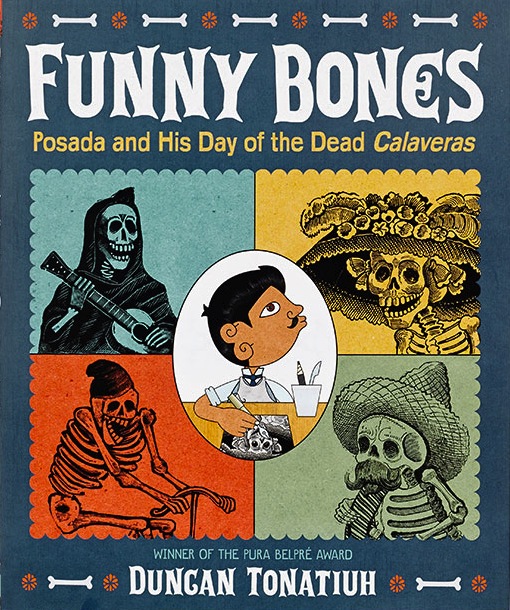
Author/illustrator Duncan Tonatiuh is one of my current favorites. I love not only the abundance of cultural and historical information in his picture books but his art style is simply amazing. It’s so smooth and modern while being unique and a throwback to his indigenous Mexican heritage. Does it get better than that? Not really and that’s why I’m loving his books so much.

Because Dia de Los Muertos (Day of the Dead) is coming up soon, I’m discussing his newest book Funny Bones: Posada and His Day of the Dead Calaveras. I’ve had an interest in Dia de Los Muertos ever since I taught a lesson about it to my Korean students. I wanted to expose them to a cultural tradition that was different but similar to one of their own. Koreans celebrate a holiday called Chuseok where they honor and pray for their dead ancestors. Since there are some similarities to Dia de Los Muertos, I thought the kids might really get something out of it!

Tonatiuh does an excellent job of making culture, art critique and history accessible to kids. Some kids really enjoy the bio books and I think they’ll love this one. We learn about the life and art of Mexican artist Posada who is responsible for making the crazy and vibrant Calavera (bone people) illustrations popular. He also documented important political events like the Mexican Revolution.

What I enjoyed most about this picture book is how Tonatiuh encourages children to do art critique. He reproduces Posada’s art, blends it with his own and poses questions about the meaning of the art all while telling Posada’s story. This is awesome! Because the book is partially about Dia de Los Muertos, it encourages you to think about life and death. This may seem heavy but like the holiday, it is about the celebration of life as well as the celebration of a great Mexican artist!

Recommended for: Ages 7 and up
Great for: History, Art History, Diversity, We Need Diverse Books, Holiday, Dia de los Muertos, Day of the Dead, Artist Bio, Biography, Non-Fiction, Mexico
Book Info: Funny Bones: Posada and His Day of the Dead Calaveras by Duncan Tonatiuh, 2015 Abrams, ISBN: 9781419716478