Ruth and the Green Book

RuthandtheGreenBook

Image Credit: Carolrhoda Books (Lerner Publishing Group, Inc.), Calvin Alexander Ramsey/Floyd Cooper

Family vacations are an American staple right? They’re when we take time away from our jobs to get in a car, train or plane to travel and have fun. But can you imagine needing to rely on a little book to help you stay safe on the road? The danger isn’t from other cars or weather conditions; the danger is from people who don’t like you because of the color of your skin.


Ruth and the Green Book is a story based on real historical events. Like Ruth and her family, in the 50s, many Black families were prospering in the North but had to take precautions when traveling, especially back down South and into Jim Crow. In this story, Ruth’s dad gets a brand new car and they head from Chicago to Alabama to visit grandparents. Ruth tells the story from her perspective and we experience her confusion and anger towards segregation. She doesn’t understand why they can’t use the restroom at the gas station and why the white hotel owner won’t let them stay in the hotel but she sees the effects these events have on her family.

NegroMotoristGreenbook

Image Credit: Wikipedia.org (New York Public Library) 1940 Edition of The Negro Motorist Green-Book

“Whites Only” signs are everywhere on their journey but her family sings joyfully as they drive and enjoy each other’s company. They make do as oppressed people do! Ruth learns the hard truth about Jim Crow, but luckily a family friend along the route tells them to look out for Esso Gas Stations. Esso is one company that accepts black business. At the first Esso Gas Station they see, a black worker sells them The Negro Motorist Green Book which lists safe places for Black people to eat, sleep and rest on the road. As they travel, Ruth grows up and makes a new friend at one of the inns they stay at. The Green Book helps Ruth and her family get to Alabama safely and she reflects on how thankful she is for a nationwide network of black people looking out for each other!

I love Cooper’s illustrations. He uses muted colors of browns, greens, and blues and it gives the feel of an old soft crackly television. Warm, expressive brown faces and Ruth’s loving family are beautiful to see. I really like the design of the cover of the book with its swooping green retro font, Dad’s brand new “sea mist” green Buick, and Ruth smiling proudly as her mom holds her steadily (strength, determination and a little worry in her expression.) This book is excellent for ALL ages because it discusses an important (and probably little-known) aspect of Black History. Check it out and talk about it!


P.S. For more information on The Negro Motorist Green Book and to browse through one online, click here and here. These links are super cool. I really encourage you to take a look!


Recommended for: 1st Grade and up
Great for: Civil Rights, Diversity, Discussion, 1950s America, Jim Crow, Segregation Community, Family, Relationships, Friendship, Travel, African-American, Social Issues, Determination, Injustice, Black History Month, Black History Month Children’s Books
Book Info: Ruth and the Green Book by Calvin Alexander Ramsey/Illustrated by Floyd Cooper, 2010 Carolrhoda Books (Lerner Publishing Group, Inc.), ISBN: 9780761352556

The Book Itch: Freedom, Truth & Harlem’s Greatest Bookstore


Happy Black History Month!

Please use this concentrated acknowledgment of BLACK EXCELLENCE to learn something new and keep it with you throughout the year.

I’ll be reviewing quite a few books for Black History Month this year so I hope you’ll enjoy my posts!

TheBookItch

Image Credit: Carolrhoda Books (Lerner Publishing Group, Inc.), Vaunda Micheaux Nelson/R. Gregory Christie

The Book Itch was recently awarded the Coretta Scott King (Illustrator) Honor and for good reason. Not only are the illustrations cool but the content!! The content is gloriously heavy. It’s inspirational and thought provoking. This is a unique book.

The story is told by the son of Lewis H. Micheaux, the founder & owner of the National Memorial African Bookstore in Harlem. “Louie” as his father calls him, takes us back to 1960s Harlem, explains the significance of the bookstore and tells a story that honors his father’s brilliance and determination. The bookstore is more than a bookstore, it’s a gathering place, a refuge, and space for knowledge and politics. All types of people visit, even Muhammad Ali and Malcolm X! We get to experience Louie’s sheer amazement and adoration when he meets such powerful Black figures of the time.

I love Lewis H. Micheaux’s way with words. His catch-phrases and poetic slogans are catchy and real. “Don’t get took! Read a book!” encourages young people of color to educate themselves through reading; a message as important today as it was in 1960s America! He constantly encourages his son to read and learn so that he can sort out the truth of the world. This book doesn’t shy away from discussing civil rights and racial issues; the bookstore often hosts rallies and Micheaux jokes “Anytime more than three black people congregate, the police get nervous.” The later half of the story explores Micheaux’s close friendship with Malcolm X. As the reader finishes the book, he/she is left thinking about the power of words and are reminded that some are willing to die for freedom.

TheBookItch2

Image Credit: Carolrhoda Books (Lerner Publishing Group, Inc.), Vaunda Micheaux Nelson/R. Gregory Christie

R. Gregory Christie’s paintings are excellent at creating place and mood. He places the reader directly in Harlem, on its streets and in the bookstore with its large collection of books knowledge. He draws long lanky bodies again like he did in Freedom in Congo Square but this time he focuses on detailed faces and expressions. His palette is dark and earthy and suits the story.

Please take time to read and discuss this book! The last few pages tell more about Lewis H. Michaeux’s life and there’s a great Author’s Note. I’m so grateful that Vaunda Micheaux Nelson created this book to share her great-uncle’s story; it’s a moment of Black History that I didn’t know about. The Book Itch is one of the strongest non-fiction historical books for children to come out in 2015. Oh the power of books…and words.


P.S. I love endpapers and this book has GREAT ones! Check out some of Micheaux’s “poetry” 🙂


Malcolm X delivering a speech outside of one his favorite places, The National Memorial African Bookstore, in 1961.


Recommended for: 2nd-3rd Grade and up
Great for: Civil Rights, We Need Diverse Books, Diversity, Discussion, 1960s America, Community, Black Bookstores, Family, Relationships, Friendship, Harlem, Lewis H. Micheaux, Malcolm X, Muhammad Ali, Non-Fiction, Power of Words, Social Issues, The National Memorial African Bookstore, Determination, Injustice, Black History Month, Black History Month Children’s Books
Book Info: The Book Itch: Freedom, Truth and Harlem’s Greatest Bookstore by Vaunda Micheaux Nelson/Illustrated by R. Gregory Christie, 2015 Carolrhoda Books (Lerner Publishing Group, Inc.), ISBN: 9780761339434

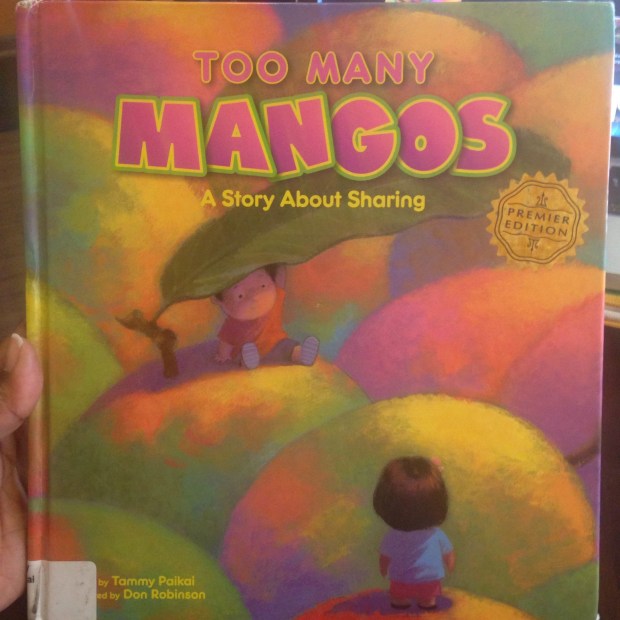
Too Many Mangos

TooManyMangos

Image Credit: Island Heritage Publishing (Madden Corporation), Tammy Paikai/Don Robinson

Hawaiian Author. Hawaiian Illustrator. Hawaiian Press. Woooo Boy! What a beautiful thing to see a completely Hawaiian product come to fruition and be shared with the world. This little book made it to my library system in Ohio and I’m glad. ❤

Too Many Mangos is gorgeous. Just look at the illustrations! Kama and his little sister Nani learn the power of kindness and sharing. Whenever they visit their grandpa’s house, they like to climb the big mango tree in the back. Grandpa tells them to pick the ripe ones and hand them down to him. There are just too many mangos for them to eat alone so he sends them to the neighbors to share. Kama and Nani head out with a wagon full of lovely mangoes and at every house, they’re given a gift in exchange for the mangos! Aunty Pua gives them fresh banana macadamia nut muffins, their friends Momi and Kawai give them golden papayas and on and on. When they finally get home, grandpa prepares a feast with all their “mahalo (thank you) gifts.” Sharing can be very sweet.

TooManyMangos2

Image Credit: Island Heritage Publishing (Madden Corporation), Tammy Paikai/Don Robinson

Robinson’s illustrations are GORGEOUS. Look at those soft pastel colors and how beautifully he blends them. His human figures are chubby and remind me of Peanuts characters. While reading this book, you’ll feel like you’re on the island in the warm sun. This is a feel good story in both content and the brightness of the illustrations. Hope you have a copy of Too Many Mangos near you so you can enjoy this delightful book! 🙂


Recommended for: All ages
Great for: Community, Sharing, Kindness, Relationships, Food Culture, Hawaiian Food, Hawaii, Cultural Diversity, Family, Friends, We Need Diverse Books, Ripe Mangos, Love, Grandfathers, Grandfathers-Grandchildren
Book Info: Too Many Mangos by Tammy Paikai/Illustrated by Don Robinson, 2009 Island Heritage Publishing (Madden Corporation), ISBN: 9781597007580


Joelito’s Big Decision

Joelito'sBigDecision

Image Credit: Hard Ball Press, Ann Berlak, Daniel Camacho, José Antonio Galloso

This book discusses making change and social justice in an easy way for children to understand. They can connect to Joelito, his friend and his struggle to make a big decision. It’ll get your children thinking about what they can do to improve our world and to ensure that everyone makes a living wage.

In Joelito’s Big Decision, Joelito wakes up Friday morning thinking about his family’s weekly trip to MacMann’s for burgers! At school, when his sister’s best friend’s backpack is stolen, he makes a comment that she can just go buy another one; he doesn’t get that his family is economically in a better place than his friend’s. Excited to finally get his burger, his family heads to MacMann’s but there are a lot of people standing outside with signs and no one’s eating. A big protest is happening because MacMann’s pays low wages and the workers can’t live on what they make. Turns out his best friend Brandon’s mom and dad work there and they’re a part of the strike too! When Brandon invites Joelito to join the strike, Joelito is hesitant (he wants to sit and eat his burger!) and he has to decide what is most important to him.

JoelitosDecision2

Image Credit: Hard Ball Press, Ann Berlak, Daniel Camacho, José Antonio Galloso

Joelito has to step outside his comfort zone. Until he encounters the strike, he doesn’t really notice that his friend’s family is struggling to make ends meet. Things become personal for him and he empathizes. Sometimes, something as simple as giving up a favorite treat can show how much you care for someone…and for a cause.

Daniel Camacho’s illustrations are very cool. I like the raw sketchy quality of the color pencil, his use of color, and the large, chunky bodies and hands of his figures. His illustrations suit the story very well. An extra treat to this book is that it’s bi-lingual (English & Spanish) and this duality will make it accessible to more children, which is excellent and needed.

I really recommend this book for discussion and learning. Teachers, look at this page from Hard Ball Press for ideas on how to use this book in the classroom!


Recommended for: 1st grade and up
Great for: Social Justice, Social Issues, Friendship, Change, Economic Inequality, Empathy, Family, Immigrants, Latin-American, Low Wages, Moving, Perspective, Poverty, Relationships, Spanish Language, Struggles, We Need Diverse Books, Diversity
Book Info: Joelito’s Big Decision by Ann Berlak/Illustrated by Daniel Camacho/Translated by José Antonio Galloso, 2015 Hard Ball Press, ISBN: 9780986240096


Mr. Tiger Goes Wild


MrTigerGoesWild

Image Credit: Little, Brown and Company (Hachette Book Group), Peter Brown

Ah, this is one of my favorites. ❤

Sometimes you just have to say screw it all and let out your inner tiger. Similar to the book Wild by Emily Hughes, this book explores themes of self discovery and acceptance in face of criticism.

Just look at his face! Look at it! He’s adorable! In Mr. Tiger Goes Wild, Mr. Tiger is in quite a predicament. His posh neighbors are very posh but for some reason he’s not feeling so posh anymore…change is coming for him and he doesn’t even realize it yet. One day, he s…l…o…w…l…y bends down on all fours (GASP!), runs around town like the wild animal he is and before he knows it, he’s NAKED! How unacceptable. His neighbors have had enough and tell him to go to the wild and so he does! But he gets lonely without his friends and when he comes home, it looks like he’s influenced them to be a little wild sometimes too. 😉

Mr.Tiger2

Image Credit: Little, Brown and Company (Hachette Book Group), Peter Brown

I love Peter Brown’s art. Though he uses mostly muted colors in this book (browns, grays, blacks, greens) there’s a vibrancy to his style. He draws blocky bodies, uses simple shapes and creates expressive faces (I LOVE MR. TIGER’S EXPRESSIONS!) with ink, watercolor and gouache. The very first spread stands out; as Mr. Tiger is surrounded by the townsfolk with their gray bodies, closed eyes and haughty expressions, you can’t help but be attracted to his annoyed expression and bright orange skin. My favorite spread is the one where Mr. Tiger slowly…drops…down…to the ground, ready to be wild!

I hope you’ll enjoy this book with your little wild ones. ROOOOAAARRR!


Recommended for: All ages
Great for: Community, Criticism, Etiquette, Proper Behavior, Self Actualization, Freedom, Friends, Relationships, Self Discovery, Acceptance, Change, Difference, Discussion
Book Info: Mr. Tiger Goes Wild by Peter Brown, 2013 Little, Brown and Company (Hachette Book Group), ISBN: 9780316200639

My Seneca Village

MySenecaVillage

Image Credit: Namelos, Marilyn Nelson


My Seneca Village is a mighty work. Marilyn Nelson, as she describes in the introduction, connected to the people of Seneca Village while spending years researching the community and this is very evident in how heartfelt and moving this collection of poems is. Seneca Village was a community in New York City located where Central Park now is. It was a community of mostly African American families, with Irish, German, Jewish and some Native Amerian residents. It existed from 1825 to 1857; in 1857 all residents were forced to move out by the city in order to build the park. With this forced removal came the end of a rich, vibrant and thriving community.

What My Seneca Village does so beautifully is bring Seneca Village back to life. Through original poems, Nelson honors and creates a voice for its residents. We learn their stories, we see young dreamers, young love, life, death, gossips, mischievous children, racism and strength. Some of the residents we meet are real people who lived in Seneca Village, others are fiction and we also meet huge historical figures, like Frederick Douglass, who stop through the village to give moving speeches. It’s hard to narrow this book into one category because it does so much. Nelson’s poetry is powerful. One of my favorite stanzas is from the village’s Reverend Rush during an anti-abolition riot:


                                      “I asked everyone to bow their heads and pray.

                                        Pray for this nation’s struggle to be free

                                        for ALL Americans. Equality

                                        must be bitter, if you’ve always been on top,

                                        and you’re slapped awake out of a lifelong sleep.

                                        Pray we’ll pull together toward a common hope.”


Over a hundred years later and we’re still struggling for the same thing. I’m glad for this story. I’m glad to know about Seneca Village, I’m glad that this novel is being read nationwide and I encourage you to read this book and travel to Seneca Village.


P.S. Just wanted to note how nice this book is. Namelos is a small publisher and I can’t remember the last time I picked up a book with such nicely inked letters.

Also, here’s an interesting NPR article about the play The People Before the Park.


Recommended for: 12 and up
Great for: Poetry, Everyday Life, Community, History, Seneca Village, American History, African American, Diversity, Cultural Diversity, We Need Diverse Books, Racism, Family, Love, Friendship, Relationships, New York, Eminent Domain, Injustice, Central Park
Book Info: My Seneca Village by Marilyn Nelson, 2015 Namelos, ISBN: 9781608981960

Drowned City: Hurricane Katrina & New Orleans

DrownedCity

Image Credit: Houghton Mifflin Harcourt, Don Brown


Drowned City
is a tough but very important read. The graphic novel element makes this story accessible to reluctant readers and Brown does a great job of recounting and documenting this part of history. It’s easy to pick up the book and learn the history, facts, heroism and the incompetency. The writing of Drowned City reads like an extended newspaper article; fact after fact with the addition of speech bubbles. The moments of dialogue help connect readers to the tragic events and the people who suffered through them.

As I read the book, I’d stare at the words and then the illustrations and I’d shake my head, memories of television news reports coming back to me. Brown’s illustrations are powerful. He uses a palette of of browns, blues, grays and purples to depict the stagnant water, stormy skies, and hopeless expressions of the people of New Orleans.

DrownedCity2

Image Credit: Houghton Mifflin Harcourt, Don Brown

One criticism I have of this book is that in the summary, Brown writes “The suffering hit the African American community hardest; a weather disaster became a race disaster” but he never addresses this in the book. Brown skin is visually noticeable in the illustrations but he doesn’t discuss the issue of race in the lack of response to the hurricane victims, or even acknowledge that most of the victims were African American. This is something I’d encourage parents and teachers to discuss.

Published in 2015, just in time for the tenth anniversary of Hurricane Katrina, Drowned City is a worthy and moving read that will provoke much discussion in your home or classroom. This book can be even more powerful when used in conjunction with real life accounts and stories from the victims themselves. A while back I compiled a group of excellent books about Hurricane Katrina for a display at my bookstore. Check out my post here for those books and be sure to pick up a copy of this graphic novel.


Recommended for: Ages 12 and up
Great for: History, Modern History, Hope, Community, Determination, Discrimination, Discussion, Economic Inequality, Incompetency, Hurricane Katrina, Inner Strength, Lack of Leadership, Leadership, Social Issues, Struggle, We Need Diverse Books, Non-Fiction, African American
Book Info: Drowned City: Hurricane Katrina & New Orleans by Don Brown, 2015 Houghton Mifflin Harcourt, ISBN: 9780544157774

Freedom in Congo Square

FreedomInCongoSquare

Image Credit: Little Bee Books (Bonnier Publishing Group), Carole Boston Weatherford/R. Gregory Christie

In this beautiful book, we learn about the slaves of New Orleans who toiled and eagerly anticipated their day of rest because on that day, they headed to Congo Square to let their bodies flow freely and revel in the music and culture of home. Congo Square was their place of freedom, their chance to celebrate who they were and simply enjoy each other’s company. Eventually Jazz would develop out of the music played at this space.

Freedom in Congo Square has an excellent Forward and Author’s Note that I highly recommend reading. Taking time to summarize and teach the history is important because it adds to the experience of the book. Children with knowledge of slavery will easily understand how important a day to rest, a day to celebrate was to slaves. It’s easy to see the joy and relief in their bodies as they dance and sing and drum. Weatherford’s poetic language and description of plantation life during each day of the week builds anticipation for what readers know is coming, that glorious Sunday.

CongoSquare2

Image Credit: Little Bee Books (Bonnier Publishing Group), Carole Boston Weatherford/R. Gregory Christie

The rhythm and rhyme of this book is great for reading aloud to children and Weatherford always has the coolest illustrators for her books. Leontyne Price: Voice of a Century is both textually and visually gorgeous. Freedom in Congo Square is no different. Christie’s collaged paintings are inspiring; the slaves have black, beautiful skin highlighted with blue-gray and long, limber bodies. Their long limbs are bent over in the cotton field BUT are also outstretched in jubilation at Congo Square. I love the bright, joyful colors of his paints and the cover of the book is striking with its use of yellow and black.

This is an excellent book that tells the story of an important safe and creative space for enslaved people during Slavery. What a great new release for 2016! If your family takes a trip down to New Orleans, why not add Congo Square to your list of places to visit?


Recommended for: 1st-2nd Grade and Up
Great for: History, Slavery, Celebration, Determination, Music, Music History, New Orleans, Community, Family, We Need Diverse Books, Diversity, Cultural Diversity, Oppression, Spirituality, Discussion, Days of the Week, Rhyme, Rhythm, Read Aloud, Jazz, African American, Africa
Book Info: Freedom in Congo Square by Carole Boston Weatherford/Illustrated by R. Gregory Christie, 2016 Little Bee Books (Bonnier Publishing Group), ISBN: 9781499801033

Growing Up Pedro

GrowingUpPedro

Image Credit: Candlewick Press, Matt Tavares

Let me get this off my chest…I’m not a baseball fan and I think that’s why it took me so long to pick up this book. I didn’t read it until I decided to participate in a Twitter Chat (SharpSchu) to discuss it. Sometimes I have to remind myself to open my eyes and embrace everything. I’m still not big on baseball but Growing Up Pedro isn’t just about baseball; it’s about the amazing relationship between brothers Ramón and Pedro Martínez.

The size of this picture book is large; it’s designed to be opened wide and fully experienced. As soon as you open the first page, you’ll see a sweeping landscape of the Dominican Republic in 1981 and little brown boys playing stickball. This sets the tone of the story where we’ll learn how two great baseball players came to dominate American baseball.

GrowingUpPedro

Image Credit: Candlewick Press, Matt Tavares

From an early age, Pedro admires his big brother Ramón’s skill and they practice together, throwing balls at the ripe mangos hanging from the trees. Eventually Ramón makes it to the LA Dodgers in 1985 and when he leaves for America, Pedro becomes more determined than ever to follow him. Ramón learns from his struggles and makes sure that Pedro is better in English than him when he’s ready to join him in the Major Leagues. Pedro isn’t as big as Ramón (this will cause some to doubt his ability) but his heart is just as big if not bigger. Heart pumping full of determination, he makes it to the Minor-Leagues just as his big brother is making waves on the Dodgers.

The brothers end up on the Dodgers, together. But before he knows it, Pedro is traded to Montreal! He continues to shine due to his inner strength and the support of his big brother. He DOMINATES as a pitcher and eventually surpasses even his brother in skill. Pedro goes to the Red Sox and later Ramón joins him again and together they lead the Red Sox to the American League Championship Series. Throughout their career, the Martínez Brothers are the pride of the Dominican Republic and never forget where they come from.

Tavares’ watercolor and gouache illustrations are dynamic. As I mentioned earlier, the wide, sweeping landscapes are gorgeous. I particularly enjoy the scenes of young Pedro and Ramón against the green trees, in shorts and caps, playing baseball with their friends and having fun! Baseball lovers will appreciate the almost photorealistic paintings of the brothers during their prime, pitching on the mound with determination in their eyes. If you’re looking for an excellent story about brotherhood, love and reaching for your dreams (oh and baseball 😉 ), pick up Growing Up Pedro!

P.S. If you buy this book, be sure to remove the jacket and check out the cover!! It’s really cool and brings the story full circle. Also, this book will be published in Spanish soon! SWEET!


Recommended for: 2nd Grade and up
Great for: Brotherhood, Ripe Mangos, Siblings, Relationships, Role Model, Admiration, Dreams, Determination, Coming of Age, Diversity, Cultural Diversity, We Need Diverse Books, Community, Friendship, Baseball, Biography, Sports, Sports History, Pedro Martínez, Ramón Martínez, LA Dodgers, Boston Red Sox, Montreal Expos, Dominican Republic, Inner-Strength
Book Info: Growing Up Pedro by Matt Tavares, 2015 Candlewick Press, ISBN: 9780763668242

Ask Me

AskMe

Image Credit: Houghton Mifflin Harcourt, Bernard Waber/Suzy Lee

Ask Me, written by Bernard Waber and posthumously published with illustrations by Suzy Lee is so sweet. The little girl in the story enjoys a fun day with her dad. As they spend time together, she asks him to ask her questions about her likes and reminds him about things she loves. They’re both attentive towards each other while being totally a part of their autumn surroundings. Their relationship is very solid and loving and I appreciate the fresh style of the writing; the story is essentially dialogue between the two. The pace and delivery of the story (also the illustrations) remind me of another great book about a father and daughter, Sidewalk Flowers.

AskMe2

Image Credit: Houghton Mifflin Harcourt, Bernard Waber/Suzy Lee

Lee depicts a messy piggy-back ice cream treat, romping through the falling leaves and dad pretending to be a bear. These are just a few of the tender moments in this book. I love the way she uses colored pencil and long, scratchy strokes to create the vibrant reds, oranges and yellows of fall leaves. Not only is the story comforting, but the colors and her sketchy-style of illustration is as well and readers will love this father-daughter relationship. What a cute book!

P.S. Another book that starts on the end pages (like Remy and Lulu)! Watch them get ready for their day out. 🙂


Recommended for: All ages
Great for: Family, Relationships, Father-Daughter, Colors, Animals, Autumn, Nature, Community, Read-Aloud, Love, Environment, Discussion
Book Info: Ask Me by Bernard Waber/Illustrated by Suzy Lee, 2015 Houghton Mifflin Harcourt, ISBN: 9780547733944